Tuesday, April 7, 2015

The Boogie Man

by Patti Brooks

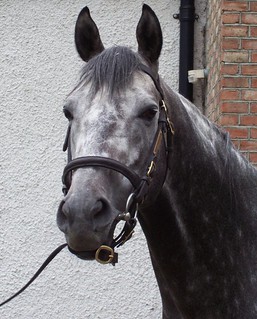
Life was scary for Tommy, a big-eyed Morgan gelding. He saw the boogie-man in everything. His official name was Trijas Tantara and his two older sisters had graduated from our Storybook Training Stable and went on to bring years of enjoyment to their owners. But Tommy.....

Our farm was located at the edge of a state forest and after serious lessons in the ring, we would take the horses out on the forest trail. That was not a plus for little Tommy. He was the only horse I ever trained that would shy at the shadow cast by a big bird  (hawk, Canada goose, buzzard) flying overhead.

Bicyclers enjoyed the state forest trail, too. Tommy was certain they were panthers. Bicyclers, hunched over their bikes, sliding quietly toward him. His equine instincts said PANTHER! And those same instincts told him exactly what to do...flee.
Tommy: "Out of Here!"

The sight of a car was enough to make Tommy break out in a sweat.  He simply lost his mind and would run blindly in the other direction.  Something had to be done. He wasn't safe to ride.

So, one day when it was everyone's day off, I turned Tommy out in our indoor ring. Then I drove our small Datsun truck in. Tommy raced to the far corner. I drove willy-nilly around, honking the horn. Then I stopped and slammed the truck door. Next I revved the engine and took off, weaving about the indoor, honking the horn.

Tommy was visibly shaking. I parked the truck in the middle of the ring, got out and let the tail gate down.  I went to the feed room and got a pail of grain which I brought to the quivering Tommy.  The grain took his mind off the truck and he gobbled a handful. Turning away from him, I walked slowly to the truck.  Tommy followed a few steps before he glanced at the monster truck and quickly turned tail.  I continued toward the truck and placed the bucket of grain on the tailgate, then walked out of the indoor.

I kept busy in the office for a good hour before coming back to check on Tommy. There he was, cowering in a corner of the indoor.  But...the pail of grain was now sitting empty on the ground.  The little guy got up the nerve to snatch the pail off the truck and carefully place it on the ground.  He obviously stayed long enough to eat the grain before retreating to his corner.
Tommy & Pam
Note all 4 feet off the ground!

Tommy took more hours of training than any horses we trained into world champions. But eventually he found a soul mate. From the moment this girl laid a hand on Tommy's neck, he immediately felt comfortable and willing to put his life in her hands. She would make his life's decisions from now on and keep the boogie man away.

Don't you think those big eyes we all think are so attractive on a horse let him see more than he needed to?

Monday, April 6, 2015

Happy Birthday

TC tosses his head at me as I pass him with the hay wagon. If his halter was hanging on the front of his stall, he would have picked it off it's hook and thrown it at me. Unfortunately for him, I pass by with the hay wagon. He hasn't subsisted on hay in two years, not since the choke incident, but he does pick at it. On certain days, he will chew on a wad of hay until he feels it's sufficiently mushy and then spit it out on the floor. The concrete in front of his stall looks like it's littered with smudge sticks.
E B Top Cat, or TC for short, will officially turn 34 years old on April 8th. On his 30th birthday, we had a barn party with treats for the horses and the guests. This year we'll celebrate with only a few, perhaps a horse-friendly cake so he can dive in and make a huge mess. I'm sure he'd be elated if we formed the current concoction of grain/hay stretcher mush into a rectangle and said it was a cake. Maybe that would only make us feel like we're celebrating. TC seems to think that any moment filled with food is a celebration. I tend to agree. We don't need frosting. We're not that fancy.
In fact, from the beginning, TC and I have had a very logical, business-like understanding. He was 27 years old and bouncing around the internet. I love older horses and have created a retirement sanctuary for them. I knew TC had a sway back and a weight limit of 125 lbs. I anticipated soundness issues, perhaps some metabolic problems. But when the older Morgan gelding walked down the ramp of the hauler and caught his first glimpse of my farm, I knew I'd made the right choice.
Inside that graying hide and pointy skeleton was the soul of a much younger horse. It's only been in the last few years that his maintenance regiment has increased. Two years ago, he choked. My vets pulled him through it and were surprised at how quickly he returned to his every day regiment, acclimating to his modified feedings. Then, about a year after that, he choked again. This time he coughed and dislodged the obstruction, only to aspirate it. At 33 years old, my vet was not optimistic. Earlier in the week, he'd had another case just like TC's and the horse was already gone. But we pumped the old gelding full of antibiotics and that night he was eating as if nothing had happened. For the next three days he was carefully monitored. Each day a vet arrived looking grim and each day they left smiling. TC's lungs cleared and he survived. Although I shouldn't be surprised.
After I brought him home, I started researching his past. I called numerous previous owners and heard stories that were larger than life. I discovered that TC is trained to ride and drive, was shown saddle seat, trail ridden by a novice and used in lessons for beginners. He drove one owner on a first date with his wife. He was on a trail ride with another owner when they halted over a ground bee nest resulting in the owner going to the hospital and an emergency vet visit for TC as he had been stung over 30 times. At some point, he became separated with another rider on a different trail ride, and ending up running into a car, breaking out their back window. Just last summer, he was cantering in the pasture with his mate and caught his toe, resulting in a perfect, slow motion forward roll.
I'm not sure when it happened. I don't think there was a specific moment, but rather a conglomeration of moments, that brought TC into full focus. The more stories I heard, the more I understood him. He's strong willed and a survivor. I enjoy every day with him. His impish nature and love of being groomed make him easy to enjoy. He is a war horse.

Thursday, April 2, 2015

Passing it Down

by Linda Benson

Just a quick photo essay about passing down the love of horses. 


Because obviously, all down through the years, this never changes:
 The Outside of a Horse is Good for the Inside of a Girl.

Sunday, March 29, 2015

The Review Conundrum

                                                                     Milton C. Toby photo

by Milton C. Toby

Book reviews come with an inherent contradiction that I have never managed to sort out to my satisfaction. We love the good reviews and pass them around shamelessly to anyone who’ll pay attention, while hating and hiding, as best we can, the bad ones. The mostly unspoken assumption is that the author of a favorable review is erudite, intelligent, and discriminating, a literary heavyweight whose opinion matters. A bad review, on the other hand, almost certainly was written by a person residing somewhere south of us on the evolutionary scale, a knuckle-dragger whose opinion can be safely ignored.

But does the perceived distinction between a good review and a bad one actually make sense? Probably not. (I’m ignoring the trolls who surf the internet and post scathing reviews just for the sake of making authors miserable. The trolls truly are the bottom-feeders of social media!)

I enjoy a good review as much as anyone, but the satisfaction is fleeting. The critical reviews, on the other hand, have been far more valuable.

Dance’s Image: The Forgotten Story of the 1968 Kentucky Derby, was an award winner with positive reviews—all except one. In a post-Derby epilogue I summarized the career of Hall of Fame jockey Bobby Ussery, who won the 1967 Kentucky Derby with longshot Proud Clarion and who finished first in the 1968 running. Although Dancer’s Image subsequently was disqualified for a controversial medication positive, Bobby Ussery still thinks of himself (rightly in my opinion) as the winner of back-to-back runnings of the most famous race in the world. I named the other back-to-back winners—it’s s short list—but in the process somehow managed to leave out the most obvious one, Ron Turcotte, rider of Riva Ridge and Secretariat.

The 1968 Kentucky Derby            George Featherston/Keeneland Library photo

One Amazon reviewer who happened to be a big fan of Turcotte’s took me to task over the omission. Getting a fact wrong is the kiss of death for a nonfiction author, and I was annoyed and suitably humbled by the one-star review. But I got over it. The bad review hurt, but it gave me the opportunity to correct the error for the book’s second printing.

A "good book, but . . ." review for Noor: A Champion Thoroughbred’s Unlikely Journey from California to Kentucky, proved to be even more valuable. The reviewer pointed out a couple of minor—but annoying nonetheless—factual errors. The review again gave me the opportunity to have the errors corrected, but it also demonstrated a fundamental shortcoming in my writing process.

I needed an independent fact-checker who knew the minutia of Thoroughbred racing and who was willing to pick through a manuscript with an eye for errors that neither I nor my advance readers noticed. I contacted the reviewer, thanked her for pointing out the issues with Noor, and asked her to check the facts in my next book, CaƱonero II: The Rags to Riches Story of the Kentucky Derby’s Most Improbable Winner. She did a great job vetting the facts in CaƱonero II and has agreed to serve as fact-checker on a book my agent is shopping around now, a history of racing’s addiction to performance enhancing drugs. I never would have connected with Val if not for a critical review.

In the end, a book review—good, bad, or indifferent—is what it is, one person’s opinion that we as authors can do with as we please.

Lord of the Rings author J.R.R. Tolkien perhaps said it best:

“Some who have read the book, or at any rate have reviewed it, have found it boring, absurd, or contemptible, and I have no cause to complain, since I have similar opinions of their works, or of the kinds of writing that they evidently prefer.”

If you’re an author, how do you balance the good reviews with the bad? If you’re a reader, how important are reviews to your book selections?

Friday, March 27, 2015

Two Authors, the Man from the CIA and his Horse

What do a Professor of History at Yale who worked for the CIA, Mario Puzo and Graham Greene have in common? Other than the fact they’re all men?

They are all authors of horse and pony stories.

Sherman Kent (1903-1986) was quite possibly the only horse story author who worked for the CIA. A Professor of History at Yale, he pioneered many methods of intelligence analysis for the CIA. He wrote on French electoral procedure, and also, one can only assume as light relief, a horse story called A Boy and a Pig, but Mostly Horses. Published in 1974 by Dodd, Mead & Company, and illustrated by the sublime Sam Savitt, A Boy and a Pig was based on Kent’s own childhood. Like the heroes of his story, he went to the Thacher School in California, where horses and riding were a major part of the curriculum. 


I love the fact there’s a pig in this story – not an animal which crops up a lot in horse stories, unless it’s there to spook the hero’s horse. Simon, the hero of the story, captures and adopts a wild pig called Augusta before going on to have an exciting holiday working on a ranch with runaway horses, a rogue mustang, and the obligatory rescue of a neglected horse.

Mario Puzo’s horse book is a more domestic affair, probably just as well bearing in mind his notorious serving up of a horse’s head on a pillow in The Godfather. The Runaway Summer of Davie Shaw (1966) is the story of a boy whose spectacularly vague parents go away, having completely forgotten to tell his grandparents he’s staying with them. Davie decides to make the most of his parent-less state by taking a pony and cart from his uncle’s home in California to New York, meeting his parents on their way back. 


While I was researching the author, I came across a first edition presentation copy of The Runaway Summer for sale at Peter Harrington, the London-based antiquarian book dealer. The dedication read: “For Carol. If you don’t like it, I’ll kill you.”

I suppose we should be grateful he wasn’t threatening her horse.

British author Graham Greene (1904-1991) is far better known for his adult stories than as a writer of children’s books. As a writer whose work portrayed Catholicism in a world which is unrelentingly full of sin and evil, I wondered quite how his children’s story The Little Horse Bus (1952) was going to turn out: just how dreadful will be the fate of the bus and its horse? There’s certainly evil there, in the shape of bank robbers who steal a hansom cab full of cash, and whip the poor horse who draws it unmercifully; and then suggest they leave her to starve to death in the wharf where they stash the cash. Fortunately, for this is a children’s book, evil is confounded and good triumphs.


All of these authors had ample experience of the bleaker side of life, and knew the depths to which humanity could plunge. It’s interesting that for them all, the horse provided a perhaps nostalgic escape to another life where endings were good and evil was confounded.


~ 0 ~

For information on many, many more horse story authors, visit my website.

Wednesday, March 25, 2015

Very Flawed Characters

by Natalie Keller Reinert

I want to piggyback off Kate Lattey's post earlier this week, "Writing Strong Female Characters." If you haven't read this post, and you're interested in the technical side of writing, definitely check it out. Go ahead. I'll wait.

You're back? Great. So, here's the thing: I have a history of writing particularly difficult female characters. Not really on purpose... they just are that way.

Alex takes a lot of flack for not being strong enough
 in The Head and Not The Heart.
But give her time. It's a series.
A lot of female characters are reluctant heroines. Think of Katniss standing up and announcing that she'll stand as tribute (or whatever she said, I only saw the movie, true fact). She didn't want to go be a human sacrifice in a particularly nasty bit of child pit-fighting, she was just aware that she was the one for the job. She was the toughest, strongest, mightiest teenager in all the land, or certainly more so than her little sister, so she did what she had to do.

Or look at the character Kris in Lattey's blog's post: "Kris is a pillar of strength, although she never sees herself that way, and (for me at least), is one of the most inspiring characters I've ever written."

Two young women who stood up and did what they had to do with a minimum of complaint. Admirable. I wish I was that sort of person, but I complain when I have to wash the dishes.

I have two main female characters in my two equestrian series: Alex, and Jules. Alex is trying to define herself in a world that does not respect her, which would be fine, if only she respected herself a little more. Jules is trying to show the world that she's the best rider in the world, which would be fine, if only she realized that she wasn't, not yet, anyway.

These flawed personalities manifest themselves in all sorts of moments that don't fit into the traditional Strong Female Character mold. It makes some people crazy, and I really don't blame them. But for others, it makes Alex and Jules incredibly realistic... sometimes maddeningly so.

As a writer, I really just set out to create characters and situations that I find realistic. Things that could happen to any of us as equestrians -- that's my number one inspiration. I never sat down and said to myself, "Alex is this sort of character and has these sorts of flaws and these sorts of attributes." It's just what happened. And so I've learned from reader reviews what sort of characters I have created.

People say...

Jules' focus on her career and distrust of
others really rubs some people the wrong way.
I look at her as a challenge. Jules, how are we
going to fix you? I'm working on that
problem now, as I write her next book.
"Her characters are so alive that I found myself mentally arguing with them over their choices as I read." - Amazon review, Turning For Home.

"It is beautifully written with strong and flawed characters... I also love how complicated Alex is. You just want to shake her half the time and admire her orneriness the other times." - Amazon review, Turning For Home.

"I became so engrossed in the characters, both human and equine, that they felt very real to me, and I cared about them. Even Jules, the main character, whose behavior at the beginning of the story is less-than-stellar (and who we occasionally want to strangle) is a compelling character, because we want to see her grow, change, and learn to accept advice, criticism, love, and friendship." - Linda Benson on Ambition.

"Our main character Jules plants the seeds of her own destruction, as do so many." - Karen McGoldrick on Ambition.

"I found the main character very unlikable, selfish and irritating." - Amazon review, Ambition.

Well, to be fair, nobody likes everybody.

Are Jules and Alex still Strong Female Characters, despite their all-too-average-human tendencies to make bad choices and completely fail at interpersonal relationships? I think so. They still have to overcome monumental challenges in their lives. They still have to step up and take control when there's no one else to do the job. I suppose they're still Reluctant Heroines… just more reluctant than most. They're growing into their roles -- and that's what the books are all about.

Monday, March 23, 2015

Setting Writing Goals

by Christine Meunier

The idea of writing a novel and getting it published can often appear like a romantic notion:
  • You have an idea and decide to write
  • Words flow and the story comes together easily and quickly
  • You complete the book and celebrate this achievement
  • You publish the book without hiccup and receive success and acknowledgement in the form of many readers and great reviews
Simple, right?
Do horses create a desire in you to write?

Perhaps not that simple.  Indeed, writing about horses is a passion.  It's something I love to do and look forward to doing.  However, at times it can also be difficult.  Not all stories flow and continue to do so until the novel is complete.

It is really important when writing, to try and set yourself a deadline to complete the task.  Make yourself accountable by setting goals to achieve and telling someone about these, so that they can check in with you.

Currently I'm writing the fifth book in the Free Rein series and I'm finding that I have to be deliberate with my writing.  That is, I've set myself a goal of writing a chapter a week, with the view of having the book complete and ready for proofing and editing by the end of April.

A common question to authors is: how do you deal with writers block?  Sometimes for me, I find that I have to just start writing and ideas will flow after I've taken the step to write something.

If you're getting into the world of writing horses, I encourage you to set writing goals and stick to them.  If you find at times that you write more than you'd hoped for - great!  Don't let that stop you from continuing on with your set goals however.  Still aim to write at least a certain amount each day or week.  Following through with writing goals will help you see the task to completion - then you can celebrate!

So what's your writing goal?