Showing posts with label history. Show all posts

Friday, May 22, 2015

My last blog post looked at horse and pony stories written during the war in the UK. It took a while before book production started to approach anything near its 1930s levels, but by the 1950s it was getting there. The war was over; rationing was coming to an end. We had never had it so good, so Harold Macmillan said. The welfare state was becoming established, employment was high. The 1950s pony book reflected the spirit of optimism of the age: they were set in an Arcadian Britain that had never existed, but perhaps, now, it might. In this post war world, riding was becoming ever more popular. In 1934, there were 103 Pony Club branches, with a membership of 8,350. By 1952, Pony Club membership had increased to 18,905, with 201 branches. PONY Magazine, started in 1949, was well into its stride, and was read by people who had no pony, nor any hope of getting one either.

The Pullein-Thompsons were now fully in their stride, with Josephine’s Noel and Henry series, Diana’s Augusta and Christina, and Christine’s Chill Valley Hounds and Phantom Horse all appearing in this decade.

Ruby Ferguson's Jill series was now joined by other pony series fiction - distinctly variable in quality. Mary Gervaise, best known for her school stories, which she had been producing in a pretty much unbroken run since the 1920s, began her G for Georgia series with A Pony of Your Own (1950). The most pony-orientated of her books, it took a genre in decline – school stories – and slapped the ever popular pony book on top of it. The series is an odd one in several ways: although billed as ponies and school, most of the books are set outside school, and there is little traditional pony adventure. Mary Gervaise doesn’t do gymkhanas. She does do outsiders, and family life, and that is what the Georgia series gives the reader; that and ponies as friends.


Mary Gervaise was joined as a series writer by Judith M Berrisford. She had been a regular contributor toPony Magazine, and had produced a range of pony stories like Timber (1950), Sue’s Circus Horse (1951) and Red Rocket (1952)which tended towards breathless adventure. With Jackie Won a Pony (1958), she started one of the lengthiest British pony series (now overtaken by Pippa Funnell’s ghost-written Tilly series). Jackie Hope wins a pony in a magazine competition, and instead of picking one of the lovely ponies she is shown, goes for a grey Welsh pony she sees pulling a cart – Misty. Unlike most ponies pulling carts in pony fiction, Misty is not ill treated. This sets the tone for the series: Jackie’s world is a safe and comfortable one, through which she crashes with her partner in disaster, her cousin Babs. In holiday adventure after holiday adventure, Jackie and Babs rush in, full of honest good intentions, and end up infuriating those around them. Everything works out in the end: these stories are safe, comfort reading.


Towards the end of the decade, Pat Smythe started producing her Three Jays series. Pat Smythe was an immensely accomplished rider, who won a bronze medal in the Stockholm Olympics in 1956. This was the first year in which women had been allowed to compete with men. In previous Olympics, Pat’s horses had been selected but she was not allowed to ride them. Her horses did not do well for other riders and they did not compete. When Pat rode them, they won. She was brave, a wonderful rider, well turned out and never grumbled. She was a heroine to ponymad children, and they bought her Three Jays series in droves. It was a clever marketing concept: all fans long to know more about their heroes, and the Three Jays series allowed the reader to imagine herself in Pat’s world. It was set in Pat’s home and stables, with her horses and staff, with the addition of the three fictional children: Jimmy, Jane and Jackie.


Georgia, Jackie and The Three Jays were all reprinted several times: but the Three Jays did not survive beyond the 1960s. When Pat retired from show jumping, and married, there was no longer the magnetic pull of her celebrity to enliven the books, but they remain as an insight into how Pat rode and thought.

~  0  ~

Thursday, April 23, 2015

The pony book in war time and beyond

My first post on this blog was on the beginnings of the pony story in the UK. In this post, I take a look at what happened next.

After Joanna Cannan introduced her heroine Jean to the world in A Pony for Jean (1936), she opened the gate to a fresh wave of stories. Ann Stafford wrote a fine holiday adventure in Five Proud Riders (1937), with young authors Katharine Hull and Pamela Whitlock contributing decent examples of ponies and holidays in their Oxus series in the late 1930s (The Far-Distant Oxus, 1937, Escape to Persia, 1938, Oxus in Summer, 1939).

With the outbreak of World War II in 1939, children's books were hit in several ways. Authors were otherwise occupied, doing war work. There was a paper shortage, leading to fewer books being published, and the introduction of the War Economy printing standard, with poorer quality paper and short print runs. (Ironically, these books are still surviving quite happily over 70 years later; many in considerably better shape than books produced a decade ago.) Books were lost when London was bombed. Moyra Charlton's Echoing Horn (1939) had most of its print run destroyed: the manuscript and illustrations of Michael Lyne's Hunting Here and There was lost altogether.

Some authors tackled the war head on. Primrose Cumming's Owls Castle Farm (1940) reflected her own war work on a farm. Her Silver Eagle Carries On (1942) saw the Chantrys struggling to keep their riding school going in war conditions. They fight even to keep their horses (horses were still requisitioned at the beginning of the war) and tackle petrol restrictions by teaching ponies to pull carts.


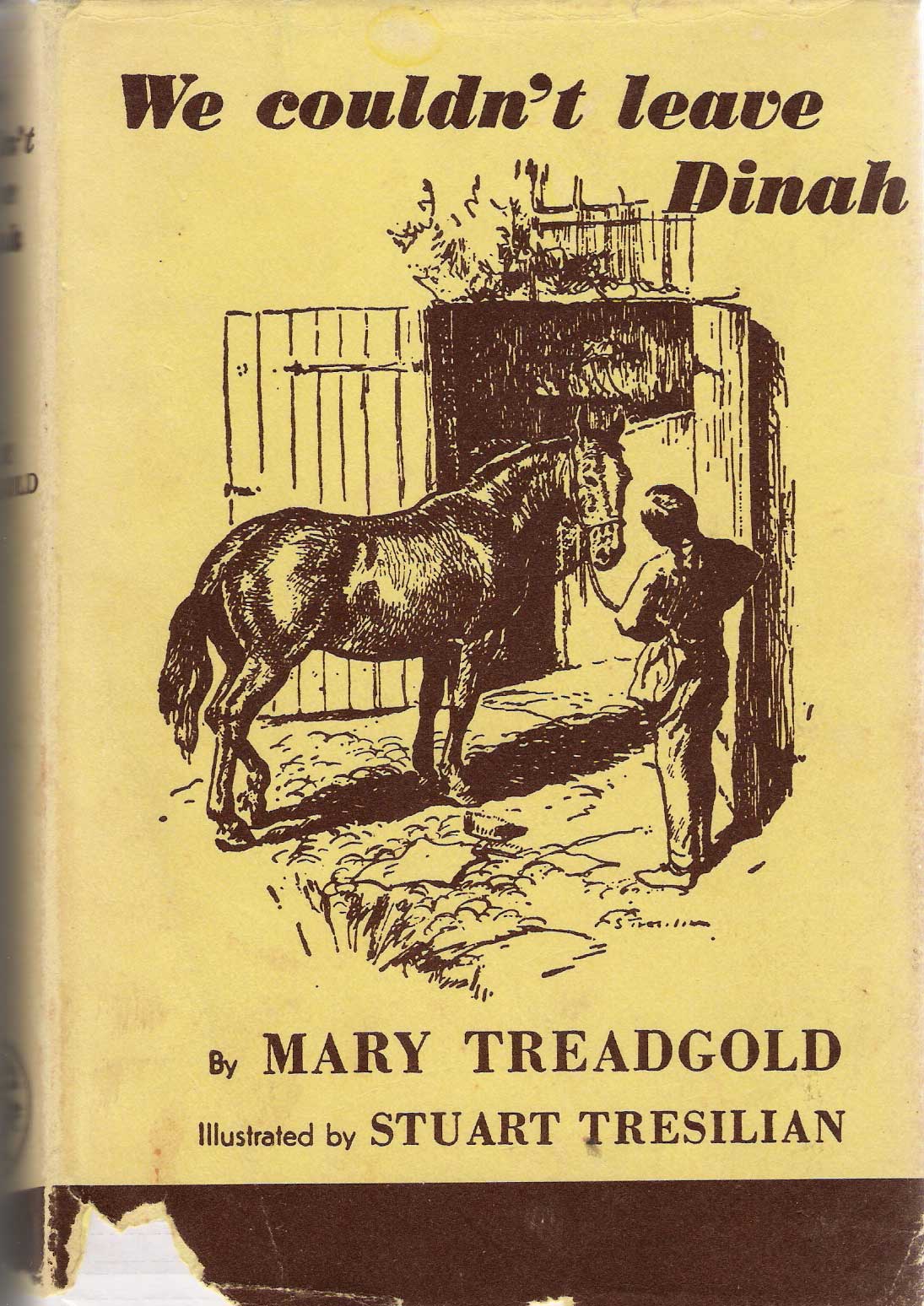
Mary Treadgold contributed Carnegie medal winning We Couldn't Leave Dinah (1941), written when she was sheltering from bombs in London. Caroline and Mick live on the fictional Channel Island of Clerinel. It is invaded by the Nazis, but in the confusion and desperate scramble of escape, the children are left behind. At a stroke, their comfortable, pony-filled life is destroyed and they are cast into a horribly uncertain existence. They no longer know who to trust, and have much to learn about how humanity tackles war. Mary Treadgold has important things to say about preconceptions and prejudice, as well as about the position ponies play in our lives. In wartime, ponies do what they had done for centuries before: ensure survival. But they also represent the land beyond war. Mary Treadgold looked at that in  No Ponies (1946),which takes place in post-war France.


Not all authors wanted to tackle the war head on: an entirely understandable reaction to the long drawn out agonies of wartime. Josephine Pullein-Thompson's first solo novel, Six Ponies, appeared in 1946, but was written when she was away on war work. It does not mention the war:
“I decided to leave the War out of the book. I was fifteen when it started, and after four years it began to look as though we would win and everything would change. No bombs, no blackouts, no rationing of food and clothes. Men would come home and organise things again. Pony Clubs would restart. There would be petrol for cars. So I tried to place Six Ponies in the future, but really it was set in the England of the 1930s.”
The Pullein-Thompsons started their domination of the pony book world. As well as Josephine's Six Ponies, Diana's I Wanted a Pony appeared in 1946, with Christine's first solo book, We Rode to the Sea,being published in 1948. The Pullein-Thompsons took the instructional story on from the thinly-disguised instructional manual it had been under authors like B L Kearley, and made it part of a world that was instantly attractive and recognisable to the pony lover.


New pony book authors entered the scene, amongst them two major figures. Monica Edwards started off her publishing career conventionally enough with two pony books: Wish for a Pony and No Mistaking Corker, in 1947. Monica did not long remain in the safe pony book field. She soon took her Romney Marsh and Punchbowl series off in other directions, in which ponies were important, but secondary to her extraordinarily vivid characters. K M Peyton, under her maiden name Kathleen Herald, wrote three books whose at times extraordinary passion set her on the path she was to fulfil in the 1960s.


Pony book series kicked off with the first Jill book. Ruby Ferguson wrote Jill's Gymkhana in 1949, ushering in a heroine whose charm has lasted until today. Jill, Black Boy and Rapide's early adventures have been republished this century. Jill's world, although in many ways a "beautiful, golden dream," reflected its post-war times. Although edited out of later editions, Jill mentions rationing; cigarettes are still in short supply, and her teacher Martin we assume was injured in the war.


The old style of pony book still limped on. The equine autobiography did not die overnight: Allen Seaby was still producing his native pony tales, and other, new authors appeared, prepared to carry on the tale the pony told itself. In the hands of young authors like Daphne Winstone, who wrote Flame in 1945 at the age of 12, it was not particularly inspired. Equestrian journalist Pamela MacGregor Morris contributed a couple of decent examples with Topper (1947) and High Honours, but she soon looked elsewhere for inspiration.

The post-war period saw the pony book really take off. In the 1950s, there was an explosion of titles. More on that soon.


~  0  ~

This piece originally appeared a few years ago on my own blog. Family circumstances mean I've been unable to write a new piece for this blog, so I hope readers will forgive me for my recycling.

Sunday, March 1, 2015

History Matters!

                                                                    Milton C. Toby photograph
by Milton C. Toby

            A report that aired recently on the CBS news program Sunday Morning caught my attention. The subject was the fate of movie props and other memorabilia from the golden age of Hollywood, iconic items such as:

          ●Dorothy’s ruby slippers and Bart Lahr’s Cowardly Lion costume from The Wizard of Oz;
          ●The piano that Dooley Wilson played in Casablanca;
          ●Marilyn Monroe’s white dress from The Seven Year Itch;
          ●The statue from The Maltese Falcon.

            All are safe and sound, in part because of the renewed interest in preserving Hollywood’s past, but mostly because such relics can be worth a ton of money. Monroe's dress reportedly was sold for $5.5 million in 2011, The Maltese Falcon statute sold at auction for $4,085,000, and the Casablanca piano and the Cowardly Lion costume each drew final bids of more than $3 million. The question is not whether Hollywood’s past should be preserved. The answer to that one from most everyone is a resounding “yes.” The burning questions these days are different: How do we preserve history? Who is going to take the lead in the preservation effort? And what about those historically important items that lack any particular monetary value?

            Horse racing is facing a similar challenge. Hollywood Park, Atlantic City Race Course, and Suffolk Downs all shut their doors in recent months, leaving in jeopardy huge archives of historically important material from all three tracks--photographs, film, video, and written matter. There is no across-the-board exit strategy for preserving the archives at America’s race tracks. If the material is going to be saved for future generations—and that is a very big “if” given the current climate—the saviors will be dedicated individuals struggling against long odds. Digitizing images and text is a step in the right direction, but who decides what is worth saving and what can be tossed?

            One of the unsung heroes in the preservation war is Kip Hannah. Kip worked as supervisor of production operations for the television department at Hollywood Park when horses still were running at the Los Angeles track. Months after Hollywood Park closed, Kip is still on the job there. Assisted by veteran pari-mutual clerk Roberta Weiser, who is volunteering her time to the project, Kip is working to organize and preserve the massive print and image archives accumulated during the track’s 75 years of operation. Hollywood Park management is funding a project to digitize film and video from all the races at Hollywood Park, but so far, no individual or group seems willing to champion the entire preservation effort.

            I got to know Kip when I was researching Noor: A Champion Thoroughbred’s Unlikely Journey from California to Kentucky. An Irish import, Noor had a banner year in 1950 racing in California for Charles S. Howard (Seabiscuit’s owner). Howard was looking for a worthy successor to Seabiscuit, and Noor was his choice to fill that role. Noor lacked the longevity of Seabiscuit, but he was a very good horse nevertheless. He defeated Citation four times in 1950, set a batch of world records in the process, and was named champion handicap horse of the year.

I contacted Kip looking for photographs of Noor and his races at Hollywood Park. The horse did most of his West Coast racing across town at Santa Anita, but in the rich Hollywood Gold Cup he became the first horse to defeat two Triple Crown winners. Noor already had Citation’s number, and an aged Assault was an also-ran in the Gold Cup. (The only other horse to accomplish the feat was the ill-fated Exceller, who defeated Seattle Slew and Affirmed in the same race, the 1978 Jockey Club Gold Cup.)

Kip quickly sent a stack of black and white photographs, many of which I used in the book, and to my surprise, a bundle of medium-format negatives he located tucked away in a filing cabinet. Although there is no way to be certain, my best guess is that the negatives never were printed and that no one had handled them in more than 60 years. Unfortunately, the negatives had suffered mightily during their decades in storage. They probably got wet, or too hot, or both. The negatives were stored in individual glassine envelopes, and the emulsions were hopelessly stuck to the glassine.

An expert in photographic restoration confirmed what I already knew, that the negatives were unusable—all except one.

The image was a good one. It shows a long-striding Noor in the morning, galloping with legendary jockey John Longden crouched low over the horse’s withers. It was perfect for the book and after some discussion with my editor we used it on the cover. I’m still excited when I pick up a copy of Noor knowing that publication of the book almost certainly marked the first time that anyone had seen the image.


Thanks, Kip!