Showing posts with label pony books. Show all posts

Monday, March 21, 2016

Setting Themes or Morals for Your Horse Story


http://www.amazon.com/Christine-Meunier/e/B00D5SE2FS/For the Free Rein series which is aimed at 8 – 12 year olds, I like to have a theme or moral of the story running throughout each novel.  Alongside this, my focus is to provide educational facts about horses in each story and cover a different area of horse care.

I want the stories to be enjoyable for readers, but to also have a suitable ending, a lesson learned and some facts picked up along the way.  I believe a particular theme or moral to stories for younger readers can be a great thing to focus on.

If you are considering writing for the younger reader, perhaps this is something you would like to consider including, too.  Because the Free Rein series books cover horses and faith, I often try to tie the title in with a horse lesson and a faith lesson.  It can be a nice way to round out the story and to help focus the theme of the book on what it is called.

Do you enjoy children’s stories with morals attached?

Friday, May 22, 2015

My last blog post looked at horse and pony stories written during the war in the UK. It took a while before book production started to approach anything near its 1930s levels, but by the 1950s it was getting there. The war was over; rationing was coming to an end. We had never had it so good, so Harold Macmillan said. The welfare state was becoming established, employment was high. The 1950s pony book reflected the spirit of optimism of the age: they were set in an Arcadian Britain that had never existed, but perhaps, now, it might. In this post war world, riding was becoming ever more popular. In 1934, there were 103 Pony Club branches, with a membership of 8,350. By 1952, Pony Club membership had increased to 18,905, with 201 branches. PONY Magazine, started in 1949, was well into its stride, and was read by people who had no pony, nor any hope of getting one either.

The Pullein-Thompsons were now fully in their stride, with Josephine’s Noel and Henry series, Diana’s Augusta and Christina, and Christine’s Chill Valley Hounds and Phantom Horse all appearing in this decade.

Ruby Ferguson's Jill series was now joined by other pony series fiction - distinctly variable in quality. Mary Gervaise, best known for her school stories, which she had been producing in a pretty much unbroken run since the 1920s, began her G for Georgia series with A Pony of Your Own (1950). The most pony-orientated of her books, it took a genre in decline – school stories – and slapped the ever popular pony book on top of it. The series is an odd one in several ways: although billed as ponies and school, most of the books are set outside school, and there is little traditional pony adventure. Mary Gervaise doesn’t do gymkhanas. She does do outsiders, and family life, and that is what the Georgia series gives the reader; that and ponies as friends.


Mary Gervaise was joined as a series writer by Judith M Berrisford. She had been a regular contributor toPony Magazine, and had produced a range of pony stories like Timber (1950), Sue’s Circus Horse (1951) and Red Rocket (1952)which tended towards breathless adventure. With Jackie Won a Pony (1958), she started one of the lengthiest British pony series (now overtaken by Pippa Funnell’s ghost-written Tilly series). Jackie Hope wins a pony in a magazine competition, and instead of picking one of the lovely ponies she is shown, goes for a grey Welsh pony she sees pulling a cart – Misty. Unlike most ponies pulling carts in pony fiction, Misty is not ill treated. This sets the tone for the series: Jackie’s world is a safe and comfortable one, through which she crashes with her partner in disaster, her cousin Babs. In holiday adventure after holiday adventure, Jackie and Babs rush in, full of honest good intentions, and end up infuriating those around them. Everything works out in the end: these stories are safe, comfort reading.


Towards the end of the decade, Pat Smythe started producing her Three Jays series. Pat Smythe was an immensely accomplished rider, who won a bronze medal in the Stockholm Olympics in 1956. This was the first year in which women had been allowed to compete with men. In previous Olympics, Pat’s horses had been selected but she was not allowed to ride them. Her horses did not do well for other riders and they did not compete. When Pat rode them, they won. She was brave, a wonderful rider, well turned out and never grumbled. She was a heroine to ponymad children, and they bought her Three Jays series in droves. It was a clever marketing concept: all fans long to know more about their heroes, and the Three Jays series allowed the reader to imagine herself in Pat’s world. It was set in Pat’s home and stables, with her horses and staff, with the addition of the three fictional children: Jimmy, Jane and Jackie.


Georgia, Jackie and The Three Jays were all reprinted several times: but the Three Jays did not survive beyond the 1960s. When Pat retired from show jumping, and married, there was no longer the magnetic pull of her celebrity to enliven the books, but they remain as an insight into how Pat rode and thought.

~  0  ~

Thursday, April 23, 2015

The pony book in war time and beyond

My first post on this blog was on the beginnings of the pony story in the UK. In this post, I take a look at what happened next.

After Joanna Cannan introduced her heroine Jean to the world in A Pony for Jean (1936), she opened the gate to a fresh wave of stories. Ann Stafford wrote a fine holiday adventure in Five Proud Riders (1937), with young authors Katharine Hull and Pamela Whitlock contributing decent examples of ponies and holidays in their Oxus series in the late 1930s (The Far-Distant Oxus, 1937, Escape to Persia, 1938, Oxus in Summer, 1939).

With the outbreak of World War II in 1939, children's books were hit in several ways. Authors were otherwise occupied, doing war work. There was a paper shortage, leading to fewer books being published, and the introduction of the War Economy printing standard, with poorer quality paper and short print runs. (Ironically, these books are still surviving quite happily over 70 years later; many in considerably better shape than books produced a decade ago.) Books were lost when London was bombed. Moyra Charlton's Echoing Horn (1939) had most of its print run destroyed: the manuscript and illustrations of Michael Lyne's Hunting Here and There was lost altogether.

Some authors tackled the war head on. Primrose Cumming's Owls Castle Farm (1940) reflected her own war work on a farm. Her Silver Eagle Carries On (1942) saw the Chantrys struggling to keep their riding school going in war conditions. They fight even to keep their horses (horses were still requisitioned at the beginning of the war) and tackle petrol restrictions by teaching ponies to pull carts.


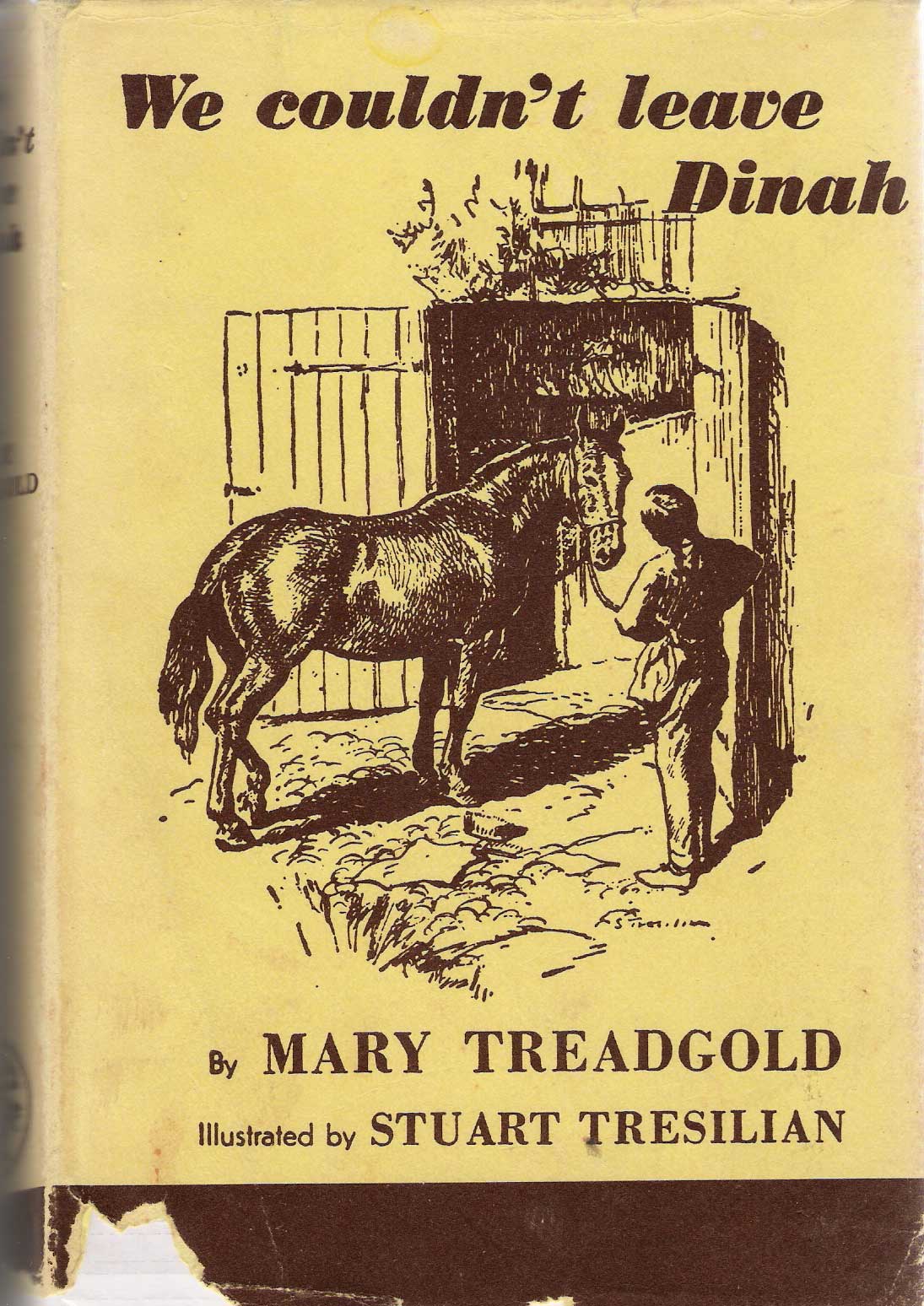
Mary Treadgold contributed Carnegie medal winning We Couldn't Leave Dinah (1941)written when she was sheltering from bombs in London. Caroline and Mick live on the fictional Channel Island of Clerinel. It is invaded by the Nazis, but in the confusion and desperate scramble of escape, the children are left behind. At a stroke, their comfortable, pony-filled life is destroyed and they are cast into a horribly uncertain existence. They no longer know who to trust, and have much to learn about how humanity tackles war. Mary Treadgold has important things to say about preconceptions and prejudice, as well as about the position ponies play in our lives. In wartime, ponies do what they had done for centuries before: ensure survival. But they also represent the land beyond war. Mary Treadgold looked at that in  No Ponies (1946),which takes place in post-war France.


Not all authors wanted to tackle the war head on: an entirely understandable reaction to the long drawn out agonies of wartime. Josephine Pullein-Thompson's first solo novel, Six Ponies, appeared in 1946, but was written when she was away on war work. It does not mention the war:
“I decided to leave the War out of the book. I was fifteen when it started, and after four years it began to look as though we would win and everything would change. No bombs, no blackouts, no rationing of food and clothes. Men would come home and organise things again. Pony Clubs would restart. There would be petrol for cars. So I tried to place Six Ponies in the future, but really it was set in the England of the 1930s.”
The Pullein-Thompsons started their domination of the pony book world. As well as Josephine's Six Ponies, Diana's I Wanted a Pony appeared in 1946, with Christine's first solo book, We Rode to the Sea,being published in 1948. The Pullein-Thompsons took the instructional story on from the thinly-disguised instructional manual it had been under authors like B L Kearley, and made it part of a world that was instantly attractive and recognisable to the pony lover.


New pony book authors entered the scene, amongst them two major figures. Monica Edwards started off her publishing career conventionally enough with two pony books: Wish for a Pony and No Mistaking Corker, in 1947. Monica did not long remain in the safe pony book field. She soon took her Romney Marsh and Punchbowl series off in other directions, in which ponies were important, but secondary to her extraordinarily vivid characters. K M Peyton, under her maiden name Kathleen Herald, wrote three books whose at times extraordinary passion set her on the path she was to fulfil in the 1960s.


Pony book series kicked off with the first Jill book. Ruby Ferguson wrote Jill's Gymkhana in 1949, ushering in a heroine whose charm has lasted until today. Jill, Black Boy and Rapide's early adventures have been republished this century. Jill's world, although in many ways a "beautiful, golden dream," reflected its post-war times. Although edited out of later editions, Jill mentions rationing; cigarettes are still in short supply, and her teacher Martin we assume was injured in the war.


The old style of pony book still limped on. The equine autobiography did not die overnight: Allen Seaby was still producing his native pony tales, and other, new authors appeared, prepared to carry on the tale the pony told itself. In the hands of young authors like Daphne Winstone, who wrote Flame in 1945 at the age of 12, it was not particularly inspired. Equestrian journalist Pamela MacGregor Morris contributed a couple of decent examples with Topper (1947) and High Honours, but she soon looked elsewhere for inspiration.

The post-war period saw the pony book really take off. In the 1950s, there was an explosion of titles. More on that soon.


~  0  ~

This piece originally appeared a few years ago on my own blog. Family circumstances mean I've been unable to write a new piece for this blog, so I hope readers will forgive me for my recycling.

Friday, March 27, 2015

Two Authors, the Man from the CIA and his Horse

What do a Professor of History at Yale who worked for the CIA, Mario Puzo and Graham Greene have in common? Other than the fact they’re all men?

They are all authors of horse and pony stories.

Sherman Kent (1903-1986) was quite possibly the only horse story author who worked for the CIA. A Professor of History at Yale, he pioneered many methods of intelligence analysis for the CIA. He wrote on French electoral procedure, and also, one can only assume as light relief, a horse story called A Boy and a Pig, but Mostly Horses. Published in 1974 by Dodd, Mead & Company, and illustrated by the sublime Sam Savitt, A Boy and a Pig was based on Kent’s own childhood. Like the heroes of his story, he went to the Thacher School in California, where horses and riding were a major part of the curriculum. 


I love the fact there’s a pig in this story – not an animal which crops up a lot in horse stories, unless it’s there to spook the hero’s horse. Simon, the hero of the story, captures and adopts a wild pig called Augusta before going on to have an exciting holiday working on a ranch with runaway horses, a rogue mustang, and the obligatory rescue of a neglected horse.

Mario Puzo’s horse book is a more domestic affair, probably just as well bearing in mind his notorious serving up of a horse’s head on a pillow in The Godfather. The Runaway Summer of Davie Shaw (1966) is the story of a boy whose spectacularly vague parents go away, having completely forgotten to tell his grandparents he’s staying with them. Davie decides to make the most of his parent-less state by taking a pony and cart from his uncle’s home in California to New York, meeting his parents on their way back. 


While I was researching the author, I came across a first edition presentation copy of The Runaway Summer for sale at Peter Harrington, the London-based antiquarian book dealer. The dedication read: “For Carol. If you don’t like it, I’ll kill you.”

I suppose we should be grateful he wasn’t threatening her horse.

British author Graham Greene (1904-1991) is far better known for his adult stories than as a writer of children’s books. As a writer whose work portrayed Catholicism in a world which is unrelentingly full of sin and evil, I wondered quite how his children’s story The Little Horse Bus (1952) was going to turn out: just how dreadful will be the fate of the bus and its horse? There’s certainly evil there, in the shape of bank robbers who steal a hansom cab full of cash, and whip the poor horse who draws it unmercifully; and then suggest they leave her to starve to death in the wharf where they stash the cash. Fortunately, for this is a children’s book, evil is confounded and good triumphs.


All of these authors had ample experience of the bleaker side of life, and knew the depths to which humanity could plunge. It’s interesting that for them all, the horse provided a perhaps nostalgic escape to another life where endings were good and evil was confounded.


~ 0 ~

For information on many, many more horse story authors, visit my website.

Friday, February 27, 2015

The Books that Crossed the Pond

When I was growing up in Britain, there was no such thing as an ebook. No one had computers. Amazon hadn’t been thought of. I didn’t even have a book shop. I had to rely on toyshops (never a hardship to go in, of course), Boots the Chemist, who then had a large toy and book department, and the library.

I was lucky with our library. When I first started going there, it was quite obvious that many of the children’s books had been there for decades. It hadn’t yet been pruned of the old and familiar (that was to come). There were rows of blue Chalet School books and tatty Dr Dolittles. Enid Blyton had an entire bookcase to herself. And there were rows of American books too. The Bobbsey twins lived in a whole new exciting universe. Maple syrup! Who knew such a thing existed? It certainly didn’t in 1970s Britain, where a new flavour of Angel Delight was a major excitement.


The library also had Rutherford G Montgomery’s Golden Stallion series. They lived tucked out of the way behind a stone pillar, on the bottom shelf. No one else in our town seemed interested in them; no one else ever stopped me from sinking into the world of Charlie, his stallion Golden Boy, and the Bar L Ranch. This world was just as far away from me as the Bobbseys and their maple syrup, but the horses made it connect with me on a completely different level. I may not have had the faintest idea what it was like to round up cattle, who round us lived calmly in hedge-surrounded fields, but I knew what it was like to ride, and through Rutherford G Montgomery I lived in that world.


Walter Farley’s world was a whole new level of exotic. Boots provided where the library failed; a British publisher, Knight, issued a few of the Black Stallion series in paperback, and I bought them. I longed, more than anything else, for a pony, and I read book after book where girls managed to get hold of one, generally through considerable sacrifice, or sheer, blinding, luck. Alec got his horse because they were ship wrecked together. And what a horse. Like Golden Boy, the Black was no scruffy riding school pony, slopping round the ring half asleep on his third lesson of the day. The Black was hot stuff. He was dangerous. He raced. 


Even where American books did involve ponies, like Marguerite Henry’s Misty series, there was still the environment to contend with. In Britain we are lucky in having weather that is generally pretty benign. Epic floods are thankfully rare. The Chincoteague and Assateague Islands and their dramatic floods again had that gloss of the alien and exciting. But the hero and heroine here, Paul and Maureen Beeby, led a life much more familiar to me. I sympathised with their longing for a pony, and cheered when they got one. 


All these American series fed that great desire so many children have to have a horse or pony of their own, but their settings made them almost impossibly exotic. New York, the Bar L Ranch and Chincoteague were as far away from my small, muddy Midlands town as it was possible to be. I now know that there were many, many American horse stories written in the way I was familiar with. A fair few were published in the UK, but they never made it out as far as the Midlands. It was the gallopingly exotic that seemed to sell here. And it still does. The Black Stallion and Misty books are still in print, enchanting new readers with a world to which the horse provides the key.

~ 0 ~

You can read more about the authors I've talked about on my website:


Friday, February 20, 2015

I don't want to be somebody who used to ride

by Kate Lattey

I have always loved horses. As far back as I can remember, I had pictures of horses on my walls, read book after book with ponies in them. I even strapped a pillow to the bannister of our staircase for a saddle and tied a rope around the upright to create a bridle, and the unimaginatively-named “Brownie” and I headed off on many adventures.

My first taste of the real thing came when I was about seven years old, at a Kindergarten fundraiser that offered pony rides. “Pony” wasn’t the most accurate description of the huge Clydesdale mare, but I dutifully paid my 20c and perched up on top of her as she ambled around the park. The pony books I’d already devoured went flying through my head, as I imagined myself on par now with those heroines and heroes who galloped recklessly across the countryside, the smell of fresh air and heather in their nostrils. I took a deep sniff myself, wanting to have a personal experience to apply to such descriptions, but all I got was (as later recounted to my mother) “a sort of poo-ey smell coming from the horse!”

I began riding lessons when I was ten, presumably to prevent me from wearing the bannisters out completely, and two years later my parents agreed to buy me a pony of my own. A palomino mare turned up on trial, and it seemed as though I’d tumbled headfirst into my daydream. My very own perfect golden pony out in the paddock, visible from my bedroom window…it was like something out of a book! I was lucky enough to have grown up on a farm, although my parents weren’t horsy folk, and I’d spent the past year working at the riding school every weekend, leading scruffy ponies through the mud and learning how to tack up and untack and pick out hooves and avoid being bitten, so although I was still very green, I had a solid foundation to start from.

As it turned out, that palomino mare was not my dream pony. She was extremely moody and stubborn, I could barely get her to trot let alone canter, and when she bit me while I was out talking to her in the paddock one afternoon, we decided we could probably do better for a first pony. She was sent back, and the search resumed.

It didn’t take long. After one disastrous attempt trialling a beautiful dark bay pony who bolted on me, I learned to judge by more than appearance, and we found a pony just down the road from us who was apparently as quiet and safe as can be. For the nervous child that I was back then, he seemed to tick all the boxes, and as soon as I sat on Whisper’s back I knew I was in safe hands (or hooves, as the case may be). Dutifully purchased and ridden home across the neighbouring paddocks, my life with ponies and Pony Club began.

Early days at Pony Club on Whisper (left)

Whisper was followed quickly by Tessa, about six months later, who came from just a little further down the road, due to Whisper’s unfortunate health problems. (He stuck around for another couple of years, but passed away in the paddock about three years after purchase. He was the sweetest pony though and I was very lucky to have had him.) Tessa was a solid-built chestnut mare with a heart of gold but no great enthusiasm to go any faster than absolutely necessary, and she gave me an immense amount of confidence.

My first One Day Event on Tessa

Two years of Pony Club went by, and I went from being the nervous kid who was barely brave enough to canter, to one whose reluctantly cobby pony was holding back her ambitions. And so Tessa was put on the market and we started looking around. A local family were selling a gorgeous pinto pony with the wonderful name of Mr Mistoffolees, but he was deemed by my parents to be “too expensive”, and we shortly afterwards bought a mare for half the price, after travelling for 2 hours to see her. (To this day, it’s the furthest I’ve ever gone to buy a horse!)

Minnie was a feisty, hot Anglo-Arab mare with a shining bay coat and a pretty head with a white star. She loved to move, hated to stand still, loved to race, and hated to jump. Unfortunately we had bought her as a jumper, but my ambitions to compete in eventing and show jumping competitions were quickly scuppered as she refused to jump, again and again. And as I fell off, again and again. I was eliminated at the first fence in most competitions we entered – in fact, in the ten years that I owned that pony, we only ever managed to jump two clear rounds (they were so rare that I remember them both clearly!).

Minnie warming up for a XC round -
we had something like 20 refusals this day!

It was a bitterly disappointing time, and sometimes I still look back and feel regret that we had bought a pony who had not been what she’d been sold to us as – a bold jumper who would never refuse. A bit of investigation post-purchase revealed that she had a reputation for refusing and had been doing so for many years. A harsh life lesson to learn about believing what you’re told!

I did discover, however, that Minnie’s strength lay in mounted games, and we started competing seriously at gymkhanas, raking in the ribbons. Flag race, barrel race, bending, tin can, potato race…you name it, she'd win it - and when she didn't, it was usually my fault. Now it was me letting my pony down, and we practiced hard to reduce the chance of that happening! We still crashed and burned in the jumping events, but we won almost everything else.

Then one of my friends who was grazing her stunning grey Arab pony at our farm turned 17. In those days, the day a rider turned 17 was the day they could no longer compete on a pony in most New Zealand competitions. (Here, almost everyone starts out on ponies and only moves on to riding horses when they are either far too tall, or have turned 17 and aged out of pony classes. Ponies are highly valued and can go for a lot more money than a horse of similar age and ability, and we have some exceptional ponies competing in this country.) My friend offered me the ride on her pony until he was sold, and said I could take him to a show on the weekend.

A hasty last-minute entry and I turned up to Levin Sports with two ponies in the float, feeling quite serious and professional. Minnie turned her usual tricks, refusing most of the jumps and getting us eliminated in every class, but Caddie was quite the opposite. Although we didn’t manage any ribbons, he jumped four clear rounds for me that day and I went home on cloud nine. It wasn’t my fault that my pony wouldn’t jump. It wasn’t because I couldn’t ride, or didn’t want it enough, or wasn’t aggressive enough, or any of the other myriad reasons that I (and other people) had given me for why I was failing so spectacularly with my other pony. It was not my fault. I think I’d known that, deep down, or at least had wanted to believe it. However those doubts had already instilled in me a determination to be the best, most accurate and balanced rider possible, to give my pony every opportunity to excel, and that determination still carries me through today.

Breezing around the XC on Caddie the day after I bought him
 I wanted to buy Caddie then, more than anything. His owner wanted me to have him, knowing it would be a good home. My parents said “But we already bought you a pony. It’s not our fault that she’s no good at jumping.” So we brainstormed a solution, and it was this – they would buy Caddie, and I would pay them back by working at our family plant nursery every weekend for the next year.

So I did. I got up early on Saturday mornings and washed pots and potted plants and weeded gardens and hated every minute of it. Then I got up early on Sunday mornings and we trundled off in the horse float with Caddie (and sometimes Minnie too) to One Day Events and show jumping competitions. The day after we bought Caddie I took him to a show, and finished 2nd in the Pre-Training (80cm/2’9”) eventing class, with the first clear cross-country round I had ever jumped in my life. One year later, at the same event, we won the Training (95cm/3’) class with one of the best show jumping rounds I’ve ever ridden in my life. 

Caddie was sold shortly afterwards before I went to University, and went to a loving home where he lived well into his 30s. Minnie stayed with me – nobody else wanted her – until she broke her leg in a paddock accident almost ten years to the day that I bought her. No matter the heartache she’d caused me over the years, it was one of the worst days of my life when I found her in the paddock with one leg held up, looking at me with such relief that I was here now and would fix it.

After I graduated, I was supposed to get an office job and live in the city. This was my mother’s plan for me, and what was expected of me, and I did both of those things. But I also got a job teaching riding on weekends, and for a year and a half I commuted back and forth every weekend to trudge around the paddocks chasing reluctant ponies, and stand in the middle of the indoor school chanting “Up, down, up, down” at small children. It was hard work, but it was rewarding and it was fun.

When I decided to go to a summer camp in America, half of the appeal was the chance to go over there and ride. Pony Club Camp was always the highlight of my year and the thought of three months of pony camp instead of just one week was an intoxicating one. My first summer in New Hampshire set the tone for what was to be a huge part of my life. I returned to the camp four more times, have visited twice since, and am currently planning to return in a couple of months’ time. It truly is my home away from home, and is where I met the horse that I will always remember as my soulmate.

Bittersweet, the best horse I've ever ridden

After camp, I started going on to work somewhere else - but still not far from horses. No point in going to England to work in an office when you can work on a livery yard, right? I spent nine months living in a trailer in Epsom, working 10 hour days looking after other people’s horses for a pittance of a salary and a day and a half off a week, learning about dressage, and hacking around the Common in the frosty mornings.

Riding Kaneel, one of our livery horses in England

Later, I worked in Ireland for nine months, in a tiny village on the outskirts of a castle, taking tourists for rides around the castle grounds on homebred Connemara ponies, and spending hours drinking mugs of strong tea in the kitchen of the family home (the only warm room in the house!).

A rare sunny day in Ireland with Connemara pony Spruce
 Since returning to New Zealand, I have bought myself a lovely Welsh Cob x Thoroughbred gelding, who originally came to me as a greenbroke six-year-old who just needed some mileage. He’s now a serious prospect in Show Hunter (Hunter Jumper) competition, and with his cheeky personality and “pony brain”, he’s a blast to have around.

My current horse JJ (Fox in Socks)
 
I have always read pony books and have been writing pony stories since I can remember. I used to cut photos out of magazines and paste them into a special blue hardcover notebook that I had. Each page belonged to a different character, and showed all of the ponies that they "owned". Some of those characters (and their ponies) are still around in my stories today - Brad & Pip Harrison, Pete & Susannah Andrews, Steph Marshall and Abby Brooks all had their origins in that old notebook.

Writing is hard, and time consuming, and infinitely rewarding. I write the books I want to read, the stories that I couldn’t find as a pony-mad child. Books that reflected my own experiences, about people growing up in New Zealand, riding down the beach to get to Pony Club rallies, and camping out in their scruffy old horse trucks at shows every weekend. Chasing sheep and jumping gorse bushes and riding with just a piece of baling twine around their pony’s neck, dumping each other in water troughs and riding in gumboots and shorts, building jumping courses out of old metal drums and spindly tree branches. Being responsible for their own ponies, learning from their mistakes, getting knocked down and getting back up again. Not always winning, not always succeeding, but learning to put their pony first, no matter what.

Horses are inescapable. They get into your blood and you can’t walk away. There’s a line in my first novel “Flying Changes” that I wrote many years ago, when I was battling to continue working with horses instead of spending my life in an office. They are words that I’ve lived by since, and hope to continue to live by for the rest of my life.

I don’t want to be someone who used to ride. 


Check out my books Flying Changes, Dare to Dream and Dream On on Amazon, and visit my website at http://nzponywriter.com for reviews and upcoming releases!