Early this morning when I was out feeding the horses, I heard squawking and calling from an unseen flock of birds just over the tree line. It was a familiar sound, but only in autumn. It was a sign that the time was indeed changing no matter how warm the weather felt. The birds knew and were gathering. My area in the Mid-Atlantic seems to be a fly-over state in the migratory path of many birds heading south. I enjoy hearing their passing calls to each other overhead and laugh at my terrier who maintains her air defense perimeter over the farm by running and barking at them. Other signs abound. The tips of some leaves are turning yellow, the corn stalks are dry and golden, the dark falls sooner and much faster, and the horses' coats have lost their sheen and are becoming fuzzy. Time speeds up for me each autumn. As if time is on a bobsled race downhill to December, I'm always a month or so behind.
This year, I'm preparing. I've decided that I will simplify my life as much as humanly possible in this era of plugged in/turned on and instead unplug. I'm avoiding Facebook (the monstrous time vampire that it is) and other social media robbers of time. I've already given up television, but now I'm going to take a hard look at all my activities and ask whether it feeds my spirit or helps others (or is necessary to sustain life...I'm not crazy). If not, it's going. I need more time for writing and in order to write well, I need more time for reflection. That means feeding creativity with reading good books, trying new things, learning, and all the while maintaining a wonder at the world and our surroundings. Change is hard. It is sometimes exciting, sometimes stressful. I'm taking it slow. I'm slowing that accelerating bullet train that rushes to the end of the year and instead taking a leisurely stroll, hoping to see something new along the way. Care to join me?
In the spirit of change, here's the new cover of False Gods. Hope you like it. I'm working on a sequel, taking up the story from a different character's point of view. Please visit my website at www.lrtrovillion.com and keep in touch.
Showing posts with label False Gods. Show all posts
Sunday, September 25, 2016
Sunday, July 3, 2016
Trimming the Deadwood and Other Painful Experiences
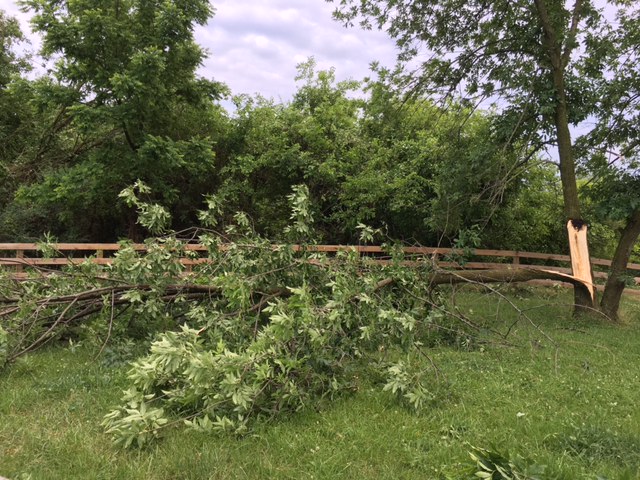
Last week a tornado hit our small town, which was quite a shock for this area of the Mid Atlantic. As roads again became passable, telephone poles replaced, electricity restored, neighbors gathered at grocery stores, churches, schools and work comparing the damage and sharing their experiences. Everyone pretty much agreed that they felt lucky it wasn't worse than it was. The damage to our farm consists of broken trees, some hanging precariously over fence lines. The man hired to remove the deadwood gave me the unfortunate news that many of my trees could not be saved. When a tree sustains so much damage and the interior is exposed, it is open to disease, infestation, and rot. My beautiful shade tree in a small paddock has to be completely removed, lest on some future date it dies and falls on the fence. This hard news made me think of writing, of course! How often do we look at our work in progress and procrastinate over making the necessary cuts...cuts that will be for the good of the whole story. The first draft of my last book, False Gods, eventually got a deadwood trimming of nearly 30,000 in order to tighten the plot, keep the pace moving, and eliminate fluff. Oh, but how we fall in love with our own fluff! At first, I snipped a few leaves and branches here and there. Then a few bare limbs. Eventually, I saw that whole chapters had to go. Clear the deadwood. Make way for new growth. Rev up that chainsaw and do what's necessary, no matter how hard it is to say good-bye to that lovely shade tree.
http://amzn.to/1TVvENR
Sunday, April 10, 2016
If You Write It, They Will Come
Lately, with the advent of spring and opening day of baseball season in the air, I'm reminded of one of the most popular baseball movies--Field of Dreams. I think what made this story so compelling was the strong faith and, yes, hope demonstrated by the main character. Based solely on a voice he hears, he plows down his cash crop corn field and builds a baseball playing field. To what end? his friends, neighbors, even family ask. At first, even he doesn't know why. That's where the faith comes in. I'm not in this instance talking about faith in the scriptural sense (although there are clear parallels in the movie), but instead faith in that voice in his head that says to step out and do something absurd, risk exposing oneself to ridicule, but do it with conviction and believe that the end result will make it all worthwhile.
How is writing a book any different from building a ball field in the middle of nowhere? Authors have to listen to that voice in their heads, the one that won't be ignored, then step out and do something so crazy your friends shake their heads, maybe even discourage you from continuing. When you put your writing out there, you are exposing the story, the characters, the writing, indeed yourself, to judgement from any and all. Who with a lick of sense would do such a thing? Writers of faith. Writers who believe if they write the story, the readers will come. Writers who have a story to tell that won't shut up and leave them alone. Writes who are willing to risk their "cornfield," whatever that may be, to do what they must do.
Now I have a story of faith to tell. I had told myself I was through with horses after a long, long run of bad luck, heartache, and financial depletion through vet bills. Quite a shame, really, since I've got a warm barn, an arena with good footing, a large stock of hay and years working with horses. But recently I started to let the idea of getting another horse seep into my consciousness. "Just for fun," I told myself, I started looking at horses for sale, but what I wanted was either out of reach or would be sold out from under me before I had a chance. Once, a major blizzard hit the day I was to go try one. It was as if fate were pushing me away, pushing in another direction. "If you build it, they will come" is one of the most repeated, often parodied tag lines from the Field of Dreams movie, but in the end it is something we all want to believe. If we prepare, if we believe, the cosmos will put the pieces together in just the right order. And that's what happened. Out of the blue, the horse came, but not at all in the way I'd imagined. Quite unexpectedly he fell in my lap--a beautiful 17 hand Thoroughbred, a lovely mover with a kind, forgiving nature. But just how this happened--I'm saving that bit of the story for another time...stay tuned!
Sunday, February 14, 2016
Four Types of Love, Greek Style
by L.R.Trovillion
It's Valentine's Day. What else am I going to write about, but love? No, I'm not a Romance writer and, in fact, have never even read a Romance novel. But does that mean that writers in other genres know nothing about love? Of course not.
Looking for inspiration on the subject of love, I turned to Internet (why not?) I knew the ancient Greeks had several words to describe the different types of love--four in fact. I decided to see if the classical descriptions of love could be found in False Gods, my debut Young Adult novel. I decided to examine the heroine, high schooler Cory Iverson, and see if she experienced all the forms of love in the course of the novel. Here's what I found (without spoilers):
Eros: This is the love we probably think of most often--the physical attraction, the spark of romance, the passionate aspect of love. This is what fuels the Romance Novel machinery. It is the heat between two lovers and all the twists and turns they must go through to find each other that makes for great stories. In False Gods there is certainly Eros. The spark between the main character, Cory, and the outsider boy in school, Kevyn, is kindled from the start. It is Eros in its most purist form--first love, new love been teens.
Storge: This type of love is often described as a dutiful love, the love of family or for one's community. One may not particularly like the other people, but still love them from a sense of loving kinship and obligation. In False Gods, Cory and her sister, Jess, have a strained relationship. They do and say things to hurt one another, but in the end, they have enough love to overcome their differences. At one point, Cory risks losing her sister's love forever, but takes a step she knows she must in order to help Jess.
Philia: This is a warm, tender, but platonic love, usually between peers or equals. It is committed, chosen love. Cory demonstrates this type of love for her friend, Regina, even though their relationship is plagued by difficulties and is threatened to be torn apart by outside influences. Cory stands by her friend no matter what and neither time nor distance changes how they feel about each other.
Agape: This is the highest form of love--one that is often used to describe God's love for his creation. It is unconditional; it accepts us for who we are and is giving without any expectation of love in return. It is sometimes described as sacrificial. According to Thomas Aquinas it is "to will the good of another" without any self-serving motivation. I thought hard about this type of love as it might appear in False Gods and decided it certainly does in Cory's love for her horse, Epiphany. In the end, Cory must make a decision, a very difficult one, involving Epiphany. When she does, she is not thinking of herself, her dreams, her desires, but instead is thinking only of the good for the horse. She demonstrates sacrificial love without any expectation of it being returned. That's agape love.
So, I found all the types of love. Does that mean I should consider marketing False Gods as a Young Adult Romance? Try this exercise on your novel, or a story you're reading now. It never hurts to think too much about love.
Happy Valentine's Day!
Labels:
agape,
classical,
eros,
False Gods,
greeks,
heroine,
philia,
Romance,
sacrifice,
storge,
Valentine's Day
Sunday, May 10, 2015
L. R. Trovillion
www.lrtrovillion.com
It is my turn to post and it happens to be Mother's Day. I would be remiss if I ignored the opportunity to say something about the influence of mothers on this, their day. I'm posting a picture of my mother that I especially like because it was a time when she was young and happy and had all the promise of life in front of her...also, because she is sitting on a horse.
My mother was not an accomplished horsewoman, but she had a love of horses, especially in her youth. I hope I've passed that on to my own daughter, whose first horseback riding experience was "in utero" (perhaps not such a smart idea) and who later spent years in pony club, junior equestrian teams, and eventing. By high school she traded in her ratcatcher and boots for a rugby shirt and cleats, but I believe her years of riding, training, and showing horses gave her a certain mental toughness that is hard to duplicate. More than that, competing in a sport with a horse--another living thing as your partner--teaches you that you are not the center of the universe. This is often a critical lesson to learn during certain teenaged years. Thank-you to the horses. Here's a picture of me and my daughter from years ago, at a time when we were both able to enjoy riding together. (Yes, I know my hair should be tied up under the helmet. I had taken it off, and just popped it back on to mount and pose for the picture.)
Horses have figured in the mother-daughter relationship in our family for two generations now, so it is no happenstance, I suppose, that it figures prominently in my novel, False Gods. Relations between mothers and daughters have been endlessly explored, examined, picked and pulled apart under the microscope of the novelist as well as the movie producer. It has provided rich, fertile ground to till for stories...and yet, there always seems to be more to say about the myriad and diverse relationships between these two female family members. The mother in False Gods has difficulty with her two daughters, but instead of it being the teenagers who are the troubled ones, it is instead the mother who suffers from emotional problems to the extent that she doesn't even notice the damage she's inflicting until it is almost too late. I won't give anything more away, except... speaking of giveaways (warning: this is where the self-promotion comes in), a contest is now running on Goodreads until May 13th to win one of seven copies of False Gods for free. I'd love to hear what other people have to say about their mothers, their relationships, and whether horses were a part of it.
Labels:
contest,
emotional problems,
equitation,
False Gods,
giveaway,
Goodreads,
horse showing,
horses,
mental toughness,
mother daughter relations,
Mother's Day,
novelist,
pony club,
rugby,
sports,
teenaged
Sunday, March 15, 2015
Why Amazon Rating Stars Are Like Dressage Scores
by Lisa Trovillion
When my book came out I compulsively checked the reviews on Amazon, tracking the number of stars. Phew! Still in the 5-star range...that's good. Or is it? Star ratings are highly subjective, and like a numbered score for a movement in a dressage test, they are an artificial indication of what the rater wants to impart. You've got to read the narrative.
I've seen star ratings range from very low to five without much written to support the score. And that's where the real meaningful information is found. A less than five rating in Amazon may be accompanied by one of the best reviews your book has ever received. There is something to be said for a book that is receiving ratings that run the gamut; It's more likely they were written by real readers and not just "friends and family." Like it or not, we can't please them all!
Similarly, I would snatch my dressage test after a ride and immediately run my eyes down to the bottom right corner to check the final score. Okay, that's human. But what I was missing was the insightful and often helpful comments accompanying the score for each phase of the test. Those comments, often complimentary, may have received only a luke warm score. The horse showed promise and was executing the movement correctly--only lacking impulsion or some other fine point that could be corrected in the next go around or the next show opportunity. Same as the criticism of a story. Take heed, because sometimes the more critical comments have something to offer (as much as we all hate to hear it.)
Although dressage judges are professionals who have studied in order to wash away all subjectivity and to produce scores based on a standardized ideal, since they are human we know this standard does not really exist. How many of us have chosen to show before a particular judge because she likes your type of horse or because she is generous with the "nines"? I'll admit it. As for readers, well, there's no real standardized ideal story, but there are elements of each and every novel that a reader will look for: conflict, characterization, pace, setting, making them care, etc. If they don't find it, they might call you out on it, and sadly, we can't always pick our readers/reviewers like we pick our judges.
I'm giving myself this lecture because I know I need it. I need to grow a thick skin and possess a brave heart. Putting a novel out there for any and all to review is scarier than riding down center line for a tough judge on a horse fresh off the racetrack.
Sunday, February 15, 2015
Make Readers Care by Lisa Trovillion
Ideas. Where do
they come from? I maintain that all creative ideas spring from one’s own
experience. Whether you are a writer who dreams up imaginary worlds full of
fanciful creatures and apocalyptic events, or a writer who drops characters
into a precise historical setting, the story you create comes in part from your
own experience. What we hope to do
as writers is make the reader care. Care about something! In order to do that,
you have to reach down inside and find that thing--maybe hiding in a dark
corner of your memory--and drag it out for all to see. It can be hard. It can be embarrassing. Maybe even a bit painful. But if we’re committed to making others
care, we have to rely in some measure on our own truest emotions and
experiences. And that doesn’t necessarily have to mean unpleasant experience.
There are writers who lift us up, make us laugh, give us a sense of hope and
inspiration. But to do so they are still stirring the embers of their past
experiences, no doubt. So now,
while reading a book, I often wonder how much of it was “true” for the
writer. I suspect it was the
portions that touched me the most.
How much of your novel is
true? How “true” is your story and where do your
ideas come from? Below, a picture of my Oldenburg mare, Dorrie, pondering whether she'll feature in my next novel.
Tuesday, February 3, 2015
What's Your Book About?
Whenever someone learns I’ve written a novel, usually the
next question out of their mouth is, “So, what’s your book about?” I have met that question with much
trepidation and fear. Don’t get me
wrong—I’m delighted that potential readers want to hear more, but I find it so
hard to sum up “what it’s about” in the course of a casual exchange.
And that is exactly what we are asked to do as writers—to
provide a one-sentence synopsis of the story, to boil down all the themes into
a tag line or a pitch. So, I go
for the obvious and throw out a few bare bones facts concerning the plot:
“There’s this girl who wants to qualify for a prestigious, big horse show
against incredible odds.” With
this, the literary agents, small publishers and maybe even a few readers stifle
a yawn and think, “Girl and her horse story. It’s been done to death.”
We might all have faced that dilemma—striving for a fresh
way to tell an old tale. Seeing
that I’m losing them, I quickly add, “But this girl’s horse may have at one
time been a world class show horse that ends up in a cheap auction’s kill
pen.” Perhaps a few readers prick
up their ears with some interest.
“But more than that. It’s
really about the girl facing her own limitations, her fears, her
insecurities.” I see some lights
come on in my listeners’ eyes, which encourages me to press on. “You see, it’s really about the nature
of desire. How what you want in
life can either twist you up and make you miserable, or liberate you and fill
the void in your life.” The thing
is, the book is about many more things: family dynamics and how wounds
perpetuate themselves, its about fear of failure, its about finding one’s
calling, it’s about how to let go without giving up.
Now, how do I get that all into one catchy line?
Subscribe to:
Posts (Atom)