Showing posts with label author. Show all posts

Monday, October 2, 2017

A New Author Website

by Christine

Well it has been an awfully long time since we've posted here!  I just wanted to share with you all that I have a new author website over at http://www.christinemeunierauthor.com/

Why not head along to take a look? :)  I have combined my two book websites into one.  Now you can find all of my horse related works in the one place!  This includes:
  • horse books for children
  • horse books for adults
  • non fiction horse books


In writing news I am currently working on the seventh book in the Free Rein series for young readers.  And I am planning to release the sixth book in the Thoroughbred Breeders series for adult readers this month!  And if you're a horse book author - or aspiring to be - don't forget about the Equine Authors website for hints and tips with regards to establishing your author presence online! :)

Monday, October 31, 2016

Scheduling Writing Time and Embracing Ideas


It is an interesting balance, finding the time and motivation to write horse stories.  The topic of horses is one I am ever passionate about.  Having the motivation to write a particular story however can be difficult at times!

I schedule time each week to work on one novel or other.  Recently I have finished and published B and B  and I still aim to bring out the sixth novel in the Free Rein series before year’s end.  That said, book 6 is being difficult!  I have half of the novel written and am struggling to continue with it.

Do you Schedule Writing Time?
In spite of this, I set myself a goal to write a chapter each week, knowing that sometimes I just need to sit and write.  When I do this, the ideas come and I get caught up in the story once again.  Writing takes real commitment at times.

Alongside working on this story, I started to toss around the idea of a series for young adults.  As I mulled it over for a week or two, I sat down to write one day and found the characters developing before my eyes.  In fact, in a 3 day period, I had written half of the first two novels in the series!

There are times when motivation strikes you and you just need to write.  Take advantage of the times when the words flow quicker than you can write – or type! – them.  Alongside this, be diligent in setting aside time to write each week so that your stories are progressing.  As a writer, it is important that you consistently invest time in your art, even when you don’t find motivation knocking on your door.  Find a balance between making use of ideas when they come to you and writing because you know your story needs to be written.

If you’re a writer, what story have you most struggled to complete?  How did you get around this?

Monday, July 11, 2016

Co Authoring Horse Stories


Perhaps it’s your desire to break into the world of writing horses, but you’re not sure where to start.  Or you’d like to do something different to further your writing career and attract a different group of readers.  Have you considered collaborating with another author?

I have recently finished reading City of Angels, which was a free download on Kindle.  It was appealing because of one author Tracie Peterson – I really enjoy her works!  I am not unfamiliar with James Scott Bell, either.  These two Christian authors have worked together to bring this story to life and I really enjoyed the read!  From having finished this novel, I would be tempted to look into other works by James Scott Bell, because of my interest in novels by Tracie Peterson.

Co Authoring Horse Stories: What do you think?
If two horse authors have a readership base, chances are some of these fans may overlap, but many won’t.  Particularly if you write about different aspects of horses – children’s books, teen stories, adult novels, equestrian, racing – whatever it is, you may find that co authoring a novel is a way for you to each compliment the other author's writing and grow your readership base.  Food for thought!

With access to many people over the internet, working together on a story wouldn’t necessarily need to be done in person.  As long as communication lines are kept open, authors may find that they can develop ideas for a plot, themes and characters via email or chat.

An added bonus could be that two creative minds can develop a strong story that is entertaining and informative with a unique twist.  And when it comes to marketing the story, there will be two lots of ideas about what works for gaining interest!

What novel have you read and enjoyed that was co authored?

Monday, June 13, 2016

Creating an Author Mailing List


by Christine.

A great way to be able to build up followers of your books is to generate a mailing list.  Fans of your book/s can sign up and receive updates as you develop as an author.  This can be particularly beneficial if you plan to write more than one novel, or establish a series.

My debut novel was a standalone novel aimed at young adults wanting to get into the horse industry.  Shortly after the release of Horse Country, an idea formed for a series for the younger reader.

Because I have an author mailing list, those keen to know about the latest releases for the Free Rein series can provide their email address and subscribe to Christine Meunier Author News.  It’s then up to me to keep them informed!
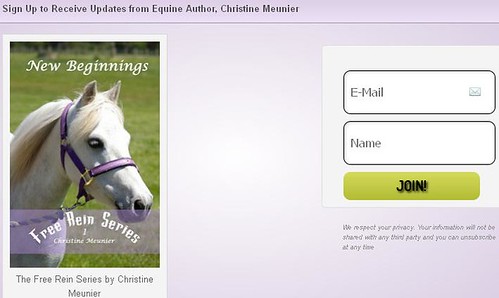
Encourage Readers to Sign Up to Your Mailing List

Once you’ve created a mailing list, you can choose how often to contact your readers: 

  • monthly
  • seasonally
  • whenever you have news

The choice is yours but it’s a great way to keep fans informed and let them know the latest news first – before you release things on your website, before you update your Facebook page and before a book is available for sale.  It’s up to you how you utilise your mailing list, but this can be a great way to keep a collection of contact details for people who are interested in buying your books.

If you provide them with the option (and link) to preorder your latest release or to give a review in exchange for an advanced copy of your planned release or to received an autographed copy of your novel/s, mailing lists can be a great way to attract fans to your readership.

The best bit is you can establish such lists for free or at a minimal cost.  I make use of MailChimp and have read many references to AWeber.  Do your research but be proactive – set up a mailing list, design a campaign and be sure to let your fans know that you want to keep them informed, if only they’ll sign up!

You can easily provide a link where people can go to sign up and direct them to this from your Twitter account, Facebook page, personal website or any other social media means.  Alternatively, you can create a pop up that encourages visitors to your site to enter their email address and sign up.

Once the mailing list is created, you receive notifications any time there is a new sign up.  You can even provide an automated response that thanks them via email for their sign up – and this email can provide them with a personal message from you, a link to where they can download a book for free or something else of your choosing.  Show your fans you appreciate them providing their contact details!

Have you signed up to your favourite author's mailing list?

Monday, May 16, 2016

Don’t Rush the Publish Date


In the age of electronic publishing, it can be too tempting to rush the publishing process.  I have read many kindle copies of books that were poorly edited with shocking grammar and spelling issues.  This is distracting and will greatly affect a rating I provide to a book.

Does it bother you?

As an author, it can be tempting to go ahead and make a book live for purchase because we feel it is finished.  Consider asking yourself first:

  • Have I had it edited?
  • Have I read it through in the format it is available for sale?
  • Have I tested how the pages / images view in the available format?
  • Can I have another set of eyes read it prior to making it public?
Have you designed a book cover, written a blurb?

A poorly prepared novel can fail with sales, in spite of being a great story.  Don’t let impatience trick you into releasing a book before it’s had the final finishing touches applied.  Practice patience!

If you find that you have announced a release date and the book isn’t ready for this date, don’t publish it anyway.  Make the necessary apologies to eager readers / fans and work to make the book available as soon as possible, in a finished state.

As you're creating a story, are you considering all that you will need to do to provide it in a finished state?
  •  a completed story
  • book cover design
  • ASIN or ISBN generation
  • a blurb
  • copyright page
  • author page
  • foreword
There are many things that need to be included with a novel, don't overlook them! :)

Wednesday, March 9, 2016

Moving


Moving. Does anyone actually look forward to it? I have spent the last month moving a therapeutic riding center forty miles. It seemed, at times, like 400 miles. Volunteers and I packed up girths, saddles, hay, horses, poles, barrels, storage sheds, water troughs, desks, filing cabinets, tires, grain, supplements, bits, polo wraps, longe lines, and much more. Then we had to unpack, inventory, put up fencing, and organize it all. Whew.


We are still a long way from being finished, but we are functional. Well, almost. We need a mounting block and a wheelbarrow, an electrician and a few more volunteers. I have no doubt that they will all eventually arrive. The best part is that we are now in a large, 54-acre facility with three creeks, a waterfall, riding and hiking trails––even a stage and dance floor.


While the move was exhausting, I also found the new location caused my creative juices to stir. As a mystery author, I always look for fun ways to involve horses, interesting people, and unique settings into my stories. This location has all that and more. I began to have so many story ideas, that I started to jot them down into the notes section of my phone. Now I am intrigued to find out which of these ideas will turn into a book or a short story. Pieces of other ideas, I am sure, will wend their way into a chapter or two, as well. 


Oddly enough, the farm is just a stone's throw away from where Cat Enright, the protagonist in my equestrian mysteries lives. When I started the series a number of years ago, I never dreamed I'd be involved with a therapeutic riding center that was so close to her fictional home.

As a writer, sometimes all it takes is a change of scenery to kick start a project, or get a book to the finish line. As you can see, I now have scenery galore! Feel free to follow the progress of the new farm on Facebook. I think we have a lifetime of projects, and ideas, waiting.


If you are ever in Ashland City, Tennessee, stop by Colby's Army for a visit.  I will probably be in a shady spot near the creek, writing.


Lisa Wysocky is an award-winning author, clinician, trainer, and riding instructor.
Find her online at LisaWysocky.com.

Wednesday, February 10, 2016

Collaboration

Collaboration. We do it all the time, whether we realize it or not. A family might collaborate to get dinner on the table. Co-workers collaborate on projects, and we horse people collaborate with our horses every time we interact with each other. When it comes to writing collaborations, however, the word escalates to a new level.

I live in Nashville, Tennessee, home of Music City. In the thirty-plus years I have lived here I have come to realize that most of the songs that are heard on the radio are written by more than one person. Collaboration. Many books are also a collaborative process. In his later years, my favorite author, Dick Francis, collaborated with his son Felix, to turn out several excellent horse-based mysteries. After Dick's passing, Felix took up the reins and continued on in an almost seamless transition.

I have co-authored several books, one being Front of the Class, the true story of Brad Cohen, an inspiring teacher with Tourette syndrome. We were thrilled when Hallmark picked it up for a Hallmark Hall of Fame television movie. Each of my writing collaborations have been unique, especially my most recent one: Eight Mystery Writers You Should Be Reading Now.


This project features eight writers within the genre of mystery. Some, like me, write fun cozy mysteries, while others write hard-boiled thrillers. The book introduces each writer with a bio, chapter from one of his or her books, a short story, and an interview. I am so proud to be grouped with such incredible authors as Lisa Alber, Jessie Bishop, Kathleen Cosgrove, Michael Guillebeau, Chris Knopf, Larissa Reinhart, and Jaden Terrell. Plus, our foreword was written by none other than bestselling author Hank Phillippi Ryan.

While we each wrote or provided our own content, the decisions about cover, sales, marketing, and many other things have been a true collaboration. What happens when you throw eight people who don't know each other well, if at all, together to make such decisions? Cooperation, encouragement, excellent ideas, and joy. This unusual grouping of people could easily have turned antagonistic and ego-driven, but that is the definitely not the case.

As authors, we all need to promote our own books, but what a refreshing thrill it has been to also plug other authors and books that I love. If you are searching for new reads, I hope you will consider these authors and their books. Even though most of the stories are non-horsey, they are good. Very good. It also includes a new short adventure from my own protagonist, horse trainer Cat Enright, as she searches for Bubba, a run-away child. Of course Sally Blue, the (possibly) psychic mare chimes in with clues. I hope you enjoy it, as well as all of the stories and chapter samples in the book.

The book is available as a kindle download on Amazon.com, but will be FREE on Feb. 20-21. Happy reading!
___

Lisa Wysocky is an author, speaker, and clinician who teaches people about the horse. She is a registered PATH instructor who also consults with therapeutic riding programs about their horse herds. Find her at LisaWysocky.com

Monday, January 25, 2016

Marketing Yourself as an Author


by Christine.

There are incredible resources online today that authors can use to sell their products, promote themselves and acquire new readers.  As an aspiring author or one who has many novels under their belt, are you using all that you can?

There are more than I am aware of, but I thought I’d list some here and their associated benefits:

  • Goodreads
    So many people today are keeping track of what they’ve read, what they thought, and what they would recommend.  As an author, you can add your books to the Goodreads database, list them in appropriate lists (e.g. best horse series), offer giveaways to promote your latest release and best of all, create an author page where all of your public works are listed.
    This list allows people to mark them as read, rate them out of 5, leave a review and even mark down that they want to read your books in the future!  If you’re not using this feature yet and have published works, I encourage you to look into it. 
  • Amazon
    Again, you can have an author profile and list all of the books that are authored by you.  Your profile can also include a biography, photo, recent blog posts from your own blog feed and Twitter updates.  It’s a great way for fans to keep in touch with your latest news and books.
    As an added bonus, if you have your books on Amazon, you can keep tabs on monthly sales, see how your book/s are faring on the best sellers lists and get reviews and ratings from purchasers. 
  •  
  • Authorgraph
    This is a nifty way to interact with your fans for free and offer them something they may not have the chance to request in person – an autograph!  The images of the covers of your published works are made available and you can create an autograph that is then placed across any of these images that a fan may request.
    For example, a reader of Horse Country – A World of Horses may fancy a signed copy of the cover from Christine Meunier.  Authorgraph is set up so that your signature is created by you and then saved – this is then sent out whenever you approve a request from a fan.  You can also personalise messages! 
  • Lulu
    If you are interested in creating paperback versions of your books, then I encourage you to check out this print on demand set up.  Lulu’s service is free to set things up – they can even help you out with book formatting, ISBNs for free and cover creation.
    You can determine if your books are available to yourself only, to only those who you invite or to the general public.  And from here, you can submit your works into bigger selling networks like Amazon and Barnes and Noble – all for free!
    They make their money through earning a percentage of your profit whenever a sale is made, not before.
    Once you have books set up on Lulu, you can set up your own author store and provide a biography, links, profile image and of course details of your released paperbacks.  You don’t have to pay to have your books printed (except for proof copies), but instead they are only printed when people order them (print on demand).  It’s a great way to cater to the one off buyers all around the world without making a dent in your pocket!

What author platform do you use that has benefited you greatly in the form of sales, reaching out to fans or keeping people updated on your latest releases?

Wednesday, January 13, 2016

Updates and Revisions

My literary agent recently arranged for me to get the rights to several of my earliest works back, a “work” being a book. This sometimes happens when a publisher closes their doors or changes focus on the kinds of books they want to publish. When a writer sells book rights to a publisher, the publisher then has the “right” to publish the book for a specific time period in ways, shapes, and forms that are detailed in the publishing agreement, but that are also usually left up to the publisher.

This means an author usually has little to no say about what the cover looks like, or the size of the type, or whether or not it ever becomes an audio book. The tradeoff is typically excellent editing; the support of sales, PR, and marketing teams; and often, a hefty advance in anticipation of solid book sales.

One of the books I got back, Success Within, is eleven years old and used to be one of my most requested books at my horse clinics and at horse fairs and expos. Used to be, until I couldn’t get copies after the publisher sold out to a company that had no interest in this particular title. Long story short, I am in the middle of the last of the revisions of the book for an updated second edition, and it should be out in March. If you are interested, my website will have news of the actual publication date.

In doing the revisions, I was both thrilled and horrified to find how much I had grown as a writer these past eleven years. Granted, I had never been happy with the final edit of the initial book, but far beyond that, I really hope this second edition will be much better written, and far more engaging. I found some of the passages in the first edition simplistic and more than a few thoughts poorly explained. Horror rushes through me when I think of people reading this early work, but that feeling is mixed with huge pride that the book touched a great many lives.

As writers, we all constantly work to improve our craft. We, hopefully, learn to streamline words when needed, develop beautiful passages of prose and place them in the right places, and both cut to the heart of the matter and communicate our point in ways that leave the reader wanting more. That is not an easy task and writers struggle every day to make that happen. When it does, we rejoice! As time goes on, the idea is that we should improve in this and in doing this rewrite, I am very glad to see that I have.

This process of updating and revising, and the strengthening of my craft of writing, is not all that different than what most of us do with horses. We constantly learn about the horse and find new ideas that will improve communication. Periodically, we reject older methods for ones that work better for the horse, and revel in the beauty of those rare moments of perfect partnership. In that way, the craft of writing and the art of riding are not all that different. 

Lisa is the author of My Horse My Partner and Horse Country, among many other books, and the award-winning Cat Enright cozy equestrian mystery series, now optioned for film and television. When not writing, Lisa is a therapeutic riding instructor who consults with PATH and other centers about their horse herds. She splits her time between Tennessee and Minnesota.

Monday, December 28, 2015

Getting Ready for 2016


by Christine.

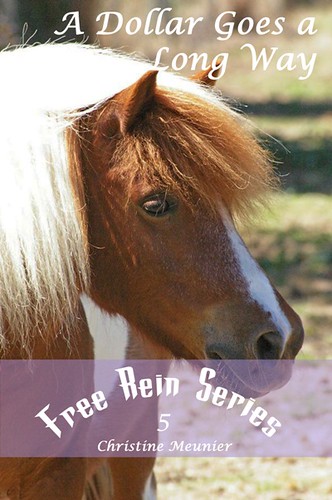
A short post from me to say that Free Rein books 4 and 5, Learning to Fall and A Dollar Goes a Long Way have been on Kindle over 2015 and it has taken me a lot longer than I hoped to get them sorted as paperbacks.  That said, they are now available in paperback form!

In Free Rein news, I am currently working on book 6 of the series and for those interested, updates are posted first over at http://www.freereinseries.com/ - you can also sign up for my author news!

For the adult reader, I am also working on a new novel set in Australia on a trail riding property.  For details on this, stay tuned to http://www.horsecountrybook.com/ - 2016 is planned for the release of two new books from author Christine Meunier.

I am also setting myself the goal of reading 150 books in 2016 and anticipate a lot of these books to be horse related - I can't wait to discover some new horse authors, read from some favourites and learn more about horses along the way!

What are your horse reading / writing plans for 2016?

Wednesday, December 16, 2015

If Horses Could Thank Us

by Lisa Wysocky

Every day I am thankful for horses, but as this year comes to an end, I know our horses are thankful for us. If they could, they would thank us for the food and shelter that we provide, because the reality is that unless a horse is born in the wild, they cannot provide this for themselves.


Our horses would thank us for the companionship of other horses. Since horses are herd animals, the safety and friendship that other horses provide is of utmost importance. They would also thank us for the veterinarian and farrier care that we give through our trusted equine medical professionals, as this is another thing that a horse cannot do for him- or herself.


I am sure our horses would also thank us for the many groomings we give them throughout the year, the care we take to be sure their saddles and other tack fit correctly, and the trail rides we take them on.


If a horse could thank us. This is not a bizarre thought, as the realty is that they thank us every day. Equine body language is subtle and complex, and their vocal tones offer distinctions that most human ears cannot detect, but from the blink of an eye, to a low whicker, to the flick of a tail, yes, they thank us.


 This "laughing horse" is actually relieving stress and tension.

It our job as equine authors to relay these complexities of horse language, thought, and behavior to the reader in an educational, engaging, and entertaining way. It is our job to also do this in a manner that drives the story (whether fiction or nonfiction) forward in words that makes sense to the reader. All of the authors here at Horse Crossings write about horses because we love them. We want our readers to care, too.


I had an editor who once questioned my use of the term “round pen.” “What is that?” she asked. When I explained how a sixty-foot round pen was used to develop leadership in the human side of the horse/human partnership she asked, “Why is it sixty feet?” I then explained that thirty feet was the average outside boundary of a horse’s personal space, so a person standing in the center of the round pen would be roughly thirty feet away from the horse. “That,” she said. “Is fascinating. You need to let your readers know.”


So I did, and with my equestrian mysteries I get just as many positive comments about the details of the equine mind as I do about the story line, or my characters. Subtly, equine authors must educate readers about the horse. If our horses knew, I am sure they would thank us because all of us, horse or human, just want to be understood.

–––––––––––––––––––

Lisa Wysocky is the author of the award-winning Cat Enright equestrian mystery series, which has been optioned for film and television. Find Lisa online at Lisa Wysocky.com, Facebook.com/ThePowerofaWhisper, Twitter.com/LisaWysocky

Monday, November 2, 2015

You can Never Stop Learning


This post is a part of the Equus Education Blog Hop: Equine Learning.  I love horses and I love learning about them.  In particular, I love that you can never stop learning about them!

One way I get to learn so much is through reading.  Textbooks, sure – I have studied at TAFE, overseas in Ireland and just finished my Equine Science Degree through Charles Sturt University and all of these courses had textbooks that helped me to learn more about horses and caring for them.

I’ve done a lot of my learning through horse fiction, too.  I first learned about the American term ‘posting’ to the trot in the Saddle Club books – and was corrected at an Australian Pony Club – here it’s known as ‘rising’!

I Learned a lot from my First Horse, Pride

I have written my six novels in the hope that they too will teach others about horses – whether it be what things are like in Australia, how to ride and care for horses or what the horse breeding industry is like in Australia and the United Kingdom.  I think for the most part, horse books allow you to learn something new, or to refresh your memory on certain facts and that’s one of the things I love about horses and reading.

What do you love about horses and learning?

Wednesday, October 21, 2015

Writing it Right, by Lisa Wysocky

As equine authors, we all want to get not only the story right, but also the horse part of it right, too. Everyone here is an experienced horse person, and has a broad base of knowledge that we incorporate into our books to share with our readers. However, it is amazing the number of little facts that creep into the story line that need to be researched, not once, but several times. We need to be thorough on our research because, if we get it wrong, at least one reader will step up to call us on it.

I think we’ve all read a book where the author gets a basic fact wrong and it takes us out of the story. That should never happen. Even in fiction, there are facts: a horse is measured in hands, a hand is four inches, there is no palomino color in the Thoroughbred breed. If we as authors get it wrong, we have done our readers a huge disservice.

I showed Appaloosa horses for many years, and the question of their point system came up in my newest Cat Enright cozy mystery, The Fame Equation. I knew how it worked. Or did I? After reviewing the current rulebook and a number of websites, I finally went to the source and called the person at the Appaloosa Horse Club who was in charge of their points system. Yes, I was right. But if I had not been, I would have alienated a lot of readers, and worse, my readers would have lost trust in me.

Quincy is a solid colored registered Appaloosa, but he looks so much like a
Thoroughbred that even his vet and farrier worked with him for
three years without realizing his actual breed.
Authors can never assume.

That is the real concern. If a reader cannot trust an author to get a basic fact correct, what about everything else the author writes? How many other mistakes, factual errors, or misconceptions are there in a given book? I write both equestrian fiction and nonfiction and am sure to find at least two credible sources for every fact I am not 1000 percent sure of. That is maybe a little over the top, but I have written a number of horse books and no reader has yet called me on a fact. I’m sure that day will someday come, and when it does, I will welcome it, for readers are truly the final authority.

• • •

Lisa Wysocky is an author, clinician, and registered PATH instructor who helps people learn about themselves through horses. Find her at LisaWysocky.com.

Monday, October 5, 2015

Around the World with Horses


One thing I love about horse novels – and indeed fictional works – is that you can travel around the world with horses and learn different cultures and hemispheres way of doing things.  There is so much to learn about horses!  Books can greatly increase your knowledge of them.

Me (far left) on a trail in South Africa
I thought I would focus this post on taking part in a blog hop titled Horse Travels over at Equus Education.  So I thought I’d focus on how we get to travel with horses in books.

In my debut novel Horse Country – A World of Horses, I explored four different women working in the horse industry or studying horses and their travels about the world.  Although the story was based in Australia (as I am), one character (Wes) travelled to Ireland to study horses and another (Maddison) travelled to England for awhile to work.

Because I have studied horses at the Irish National Stud in County Kildare, it was easier to write about the differences from Australia as I had experienced them.  Likewise, I had experienced working in a racing stable and was able to bring this into the novel.

In the Free Rein series I write for pre-teens, I explore running an agistment (boarding) property in Victoria as this is an area of interest and knowledge for me, too.  Currently I am also working on a new adult novel that explores running a trail riding business in the high country of Australia.  Updates on this novel are available through my Horse Country website.

The question of the blog hop is:
“If you could travel anywhere in the world for something horse related, where would it be and what would you do?”

I choose to travel to different parts of Australia that enable me to explore some of my favourite aspects of the horse world.  So in light of the question, perhaps you’d like to answer it?  Where would you travel and why?

Wednesday, September 23, 2015

Equine Characters

Fictional horses, just like fictional people, are fun to write. In any form of fiction, the character must have purpose in the story. One might provide comic relief, another moves the story along, a third provides important background information. Of course, every author hopes the reader will not detect any of that kind of story structure, and will simply enjoy the read.

In stereotypical tradition, the protagonist must be good, but flawed. Cat Enright, the lead human character in my horse mysteries, is loyal and loves her four-legged friends, but she has no biological family to speak of and has a teeny problem with anger management. Her sidekicks, Jon, Darcy, and Agnes, provide a voice of reason, youthful sentiment, and wacky fun, not necessarily in that order. Each balances Cat in a different way.

The horses I, or any other author, writes are no different. Gigi, the young filly in my mysteries is the usual scatter-brained young mare who is full of energy, interested in everything, and finds life so much fun! Most of us have had an experience with a young horse like that. Bob is the older, steady-Eddie gelding who might be a little dull, but who never, ever makes a mistake. If he were human, he’d be an accountant. (No offense meant to accountants in general.) Then there is Petey, who likes to grab his lead rope and lead himself back to the barn. He is an adult, but one who likes to grab his fun wherever he can find it. Anyone who has been around horses for a while has known a “babysitter” like Bob and a quirky horse like Petey.

Sally Blue is the lead equine character, and is a young(er) lead mare who is so intuitive that many of the characters in my mysteries think she is psychic. So do a number of readers. Me? I’m not taking a stand either way, because I don’t know for sure. But, many lead mares have that something extra that allows them to keep their herd safe, even when that herd includes just the lead mare and her human partner. But, Sally seems to know about things before they happen. Or, maybe she is just having a good time crossing her legs and blowing all those bubbles in her water bucket.

I love the familiarity of writing cozy mysteries. I love watching my characters grow and develop from one book to the next and have especially enjoyed watching Cat develop her own little family unit of close friends. In my third mystery, The Fame Equation (November 3, 2015), Sally teaches a new horse his place and seems to become frustrated when her human friends do not understand her many odd behaviors. Petey is being taught to pull a cart, Bob finds a new friend, and Gigi is trying very hard not to grow up.
Sally Blue is on the cover of each Cat Enright mystery.
My equine characters have not yet told me what will happen in book four, but they have given me a few hints. And that is the big difference, for me, between writing fiction and nonfiction. These characters get into my brain and direct the story far more (and far better) than I do. Other authors have told me the same thing happens to them when they write fiction. But authors everywhere, myself included, hope their characters also get into the readers’ heads. We all hope readers will think about the characters, horse or human, long after the last word has been read. When that happens, author and character alike have done their jobs.

Happy reading!

Lisa Wysocky

Wednesday, August 26, 2015

A Day in the Life of an Author

The day in the life of an author is not what most might think. Of course, it varies from author to author, just as the daily routine might vary from one accountant to another. And, when you mix horses in, the daily schedule takes on a life of it’s own.

I can’t speak for other authors, but I know that I need to write in the morning, when my mind is fresh. Usually, I do a quick read through of yesterday’s work, then dive right in. If I am writing nonfiction, something such as a book on horse training, I have an outline to follow. Those of us who publish with traditional publishers have most likely sold a proposal, a detailed outline of the proposed book, to the publisher, and the author needs to follow that outline. Nonfiction is a little easier on my brain, as I write facts, hopefully in an engaging narrative.

While other authors might outline their fiction, I do not. I know it sounds strange, but writing my Cat Enright mystery series is almost like having a conversation with my characters in my head. I sometimes even have disagreements with my characters about how the story should unfold. My saving grace on that front is that I have heard other fiction authors say the same thing.

http://www.amazon.com/Fame-Equation-Enright-Equestrian-Mystery/dp/1935270370/ref=sr_1_1?ie=UTF8&qid=1440604876&sr=8-1&keywords=the+fame+equation


I usually write for several hours, or until lunchtime. Then it is time to get down to the business of being an author. My booking and literary agents usually have sent some emails for me to respond to. When that has been dealt with I perform the necessary evils of social media and updating my website. I look over any contracts for speaking, horse clinics, writing, or “rights” sales (audio, trade paperback, foreign, etcetera), and sometimes speak to my co-authors about contracts and offers. In addition to horse books I sometimes co-author or ghostwrite autobiographies with well-known people. My books are published with a number of different publishers, so I take calls or answer their emails as well. On occasion, there is an interview to do.

By mid to late afternoon I am ready to head to the barn. Sometimes I teach a riding lesson or two, other times I feed, mow, groom, fix fences, haul hay, do groundwork, or even ride. After an early dinner I read over my morning’s work and make changes, then create a to-do list for my writing for the next day.
http://www.lisawysocky.com


Of course, there are interruptions to this basic schedule. Conferences, clinics, book signings, and speaking engagements (and the travel to and from) happen regularly. A horse might become sick, or I get edits back from my editor and hunker down for several days to get through them. Sometimes I find I just need to take a morning to pick up and organize the chaos that has developed around my writing space. But somehow, books are turned in on deadline, horses get fed, and I can’t wait to get up in the morning to start it all over again.

Monday, August 10, 2015

Know Your Audience


The latest book in the Free Rein Series
I have all of my books available on Kindle.  It’s great to be able to download the sales and lender reports each month and view which books have been purchased and from which country.

I am an Australian author and as such, my Free Rein series focuses on three young girls who have ponies in Victoria, Australia.  There are a lot of horse terms in Australia that readers from other countries may not be familiar with.  One such example is the word agistment.

Children’s author Deanie Humphrys-Dunne was kind enough to read and review one of the books in the series and separately she emailed me and suggested an inclusion of terms to my books.  The idea was that readers could turn to this and find the definition of such terms if they weren’t familiar with them.

This is a great recommendation that could improve my readers’ reading experience!  This is particularly so because my Kindle sales indicate that around 95% of my readers come from the United States and the United Kingdom.  I have now added an Australian Terms page to my Free Rein series website so that readers can do a bit of learning whilst finding out the latest Free Rein news.

What recommendation have you had regarding your writing that you’ve acted upon?

Sunday, June 7, 2015

Picking a Winner

Everyone loves a winner. Fresh on the heels of American Pharoah's win at the Belmont Stakes and capture of the Triple Crown--an honor which has eluded horses for over three decades--that love is stronger than ever.  American Pharoah's name will be captured in the record books, his story will live on, and his image will be instantly recognizable. But amidst the hoopla over what is undoubtedly a great sports history story, I still wonder about the horses whose stories will fade into the mists of history. I wonder about horses like Frosted or Sham, who might have been the winning favorites if they had just not been born in the same year as a super horse. I also wonder about the ones which almost made it--Big Brown, Funny Cide, and Silver Charm-- the ones which carried the hopes and dreams of a fickle public, only to lose in the last leg, their names generally forgotten,  and have faded into the hazy public memory by all except true racing fans. But they all had their stories to tell, winners, near winners, and ones who trailed the pack. Stories about the horses, the trainers, the owners, the grooms and everyone who helped give them a shot at the Triple Crown all have their tale to tell. But these are not the stories the public wants to hear--or what the media thinks the public wants to hear--if they are not the winners.

I can't help but equate this same message to the stories told in books. According to a recent post by fantasy author Ursula K LeGuin in The Guardian, http://www.theguardian.com/books/2015/jun/03/ursula-k-le-guin-amazon-bs-machine?CMP=share_btn_tw
she accuses Amazon's marketing approach of sell it fast, cheap, and move on of having changed the landscape of both readers and publishers. Books are offered and promoted only if they are a safe bet commercially, then those books are heavily marketed until their sales wane, and it's on to the next one. Readers are left with fewer choices. This also leaves little hope for the books with slow but steady appeal (and sales) or for ones that don't conform to the model of commercial success.  I'm not sure how the Indy author can or will affect this trend, but I would hate to think that good stories don't ever get a spot in the starting gate just because they don't have the look and feel of a commercial break out novel. Like the horses which aren't the fastest, they all still have a story to tell.

Photo credit: "The horse, the legend" at www.photopin.com; Creative commons licenses.


photo credit: <a href="http://www.flickr.com/photos/74031909@N00/1120222622">The horse, The legend</a> via <a href="http://photopin.com">photopin</a> <a href="https://creativecommons.org/licenses/by/2.0/">(license)</a>