Showing posts with label Equine. Show all posts

Wednesday, December 16, 2015

If Horses Could Thank Us

by Lisa Wysocky

Every day I am thankful for horses, but as this year comes to an end, I know our horses are thankful for us. If they could, they would thank us for the food and shelter that we provide, because the reality is that unless a horse is born in the wild, they cannot provide this for themselves.


Our horses would thank us for the companionship of other horses. Since horses are herd animals, the safety and friendship that other horses provide is of utmost importance. They would also thank us for the veterinarian and farrier care that we give through our trusted equine medical professionals, as this is another thing that a horse cannot do for him- or herself.


I am sure our horses would also thank us for the many groomings we give them throughout the year, the care we take to be sure their saddles and other tack fit correctly, and the trail rides we take them on.


If a horse could thank us. This is not a bizarre thought, as the realty is that they thank us every day. Equine body language is subtle and complex, and their vocal tones offer distinctions that most human ears cannot detect, but from the blink of an eye, to a low whicker, to the flick of a tail, yes, they thank us.


 This "laughing horse" is actually relieving stress and tension.

It our job as equine authors to relay these complexities of horse language, thought, and behavior to the reader in an educational, engaging, and entertaining way. It is our job to also do this in a manner that drives the story (whether fiction or nonfiction) forward in words that makes sense to the reader. All of the authors here at Horse Crossings write about horses because we love them. We want our readers to care, too.


I had an editor who once questioned my use of the term “round pen.” “What is that?” she asked. When I explained how a sixty-foot round pen was used to develop leadership in the human side of the horse/human partnership she asked, “Why is it sixty feet?” I then explained that thirty feet was the average outside boundary of a horse’s personal space, so a person standing in the center of the round pen would be roughly thirty feet away from the horse. “That,” she said. “Is fascinating. You need to let your readers know.”


So I did, and with my equestrian mysteries I get just as many positive comments about the details of the equine mind as I do about the story line, or my characters. Subtly, equine authors must educate readers about the horse. If our horses knew, I am sure they would thank us because all of us, horse or human, just want to be understood.

–––––––––––––––––––

Lisa Wysocky is the author of the award-winning Cat Enright equestrian mystery series, which has been optioned for film and television. Find Lisa online at Lisa Wysocky.com, Facebook.com/ThePowerofaWhisper, Twitter.com/LisaWysocky

Monday, November 2, 2015

You can Never Stop Learning


This post is a part of the Equus Education Blog Hop: Equine Learning.  I love horses and I love learning about them.  In particular, I love that you can never stop learning about them!

One way I get to learn so much is through reading.  Textbooks, sure – I have studied at TAFE, overseas in Ireland and just finished my Equine Science Degree through Charles Sturt University and all of these courses had textbooks that helped me to learn more about horses and caring for them.

I’ve done a lot of my learning through horse fiction, too.  I first learned about the American term ‘posting’ to the trot in the Saddle Club books – and was corrected at an Australian Pony Club – here it’s known as ‘rising’!

I Learned a lot from my First Horse, Pride

I have written my six novels in the hope that they too will teach others about horses – whether it be what things are like in Australia, how to ride and care for horses or what the horse breeding industry is like in Australia and the United Kingdom.  I think for the most part, horse books allow you to learn something new, or to refresh your memory on certain facts and that’s one of the things I love about horses and reading.

What do you love about horses and learning?

Wednesday, October 21, 2015

Writing it Right, by Lisa Wysocky

As equine authors, we all want to get not only the story right, but also the horse part of it right, too. Everyone here is an experienced horse person, and has a broad base of knowledge that we incorporate into our books to share with our readers. However, it is amazing the number of little facts that creep into the story line that need to be researched, not once, but several times. We need to be thorough on our research because, if we get it wrong, at least one reader will step up to call us on it.

I think we’ve all read a book where the author gets a basic fact wrong and it takes us out of the story. That should never happen. Even in fiction, there are facts: a horse is measured in hands, a hand is four inches, there is no palomino color in the Thoroughbred breed. If we as authors get it wrong, we have done our readers a huge disservice.

I showed Appaloosa horses for many years, and the question of their point system came up in my newest Cat Enright cozy mystery, The Fame Equation. I knew how it worked. Or did I? After reviewing the current rulebook and a number of websites, I finally went to the source and called the person at the Appaloosa Horse Club who was in charge of their points system. Yes, I was right. But if I had not been, I would have alienated a lot of readers, and worse, my readers would have lost trust in me.

Quincy is a solid colored registered Appaloosa, but he looks so much like a
Thoroughbred that even his vet and farrier worked with him for
three years without realizing his actual breed.
Authors can never assume.

That is the real concern. If a reader cannot trust an author to get a basic fact correct, what about everything else the author writes? How many other mistakes, factual errors, or misconceptions are there in a given book? I write both equestrian fiction and nonfiction and am sure to find at least two credible sources for every fact I am not 1000 percent sure of. That is maybe a little over the top, but I have written a number of horse books and no reader has yet called me on a fact. I’m sure that day will someday come, and when it does, I will welcome it, for readers are truly the final authority.

• • •

Lisa Wysocky is an author, clinician, and registered PATH instructor who helps people learn about themselves through horses. Find her at LisaWysocky.com.

Wednesday, September 23, 2015

Equine Characters

Fictional horses, just like fictional people, are fun to write. In any form of fiction, the character must have purpose in the story. One might provide comic relief, another moves the story along, a third provides important background information. Of course, every author hopes the reader will not detect any of that kind of story structure, and will simply enjoy the read.

In stereotypical tradition, the protagonist must be good, but flawed. Cat Enright, the lead human character in my horse mysteries, is loyal and loves her four-legged friends, but she has no biological family to speak of and has a teeny problem with anger management. Her sidekicks, Jon, Darcy, and Agnes, provide a voice of reason, youthful sentiment, and wacky fun, not necessarily in that order. Each balances Cat in a different way.

The horses I, or any other author, writes are no different. Gigi, the young filly in my mysteries is the usual scatter-brained young mare who is full of energy, interested in everything, and finds life so much fun! Most of us have had an experience with a young horse like that. Bob is the older, steady-Eddie gelding who might be a little dull, but who never, ever makes a mistake. If he were human, he’d be an accountant. (No offense meant to accountants in general.) Then there is Petey, who likes to grab his lead rope and lead himself back to the barn. He is an adult, but one who likes to grab his fun wherever he can find it. Anyone who has been around horses for a while has known a “babysitter” like Bob and a quirky horse like Petey.

Sally Blue is the lead equine character, and is a young(er) lead mare who is so intuitive that many of the characters in my mysteries think she is psychic. So do a number of readers. Me? I’m not taking a stand either way, because I don’t know for sure. But, many lead mares have that something extra that allows them to keep their herd safe, even when that herd includes just the lead mare and her human partner. But, Sally seems to know about things before they happen. Or, maybe she is just having a good time crossing her legs and blowing all those bubbles in her water bucket.

I love the familiarity of writing cozy mysteries. I love watching my characters grow and develop from one book to the next and have especially enjoyed watching Cat develop her own little family unit of close friends. In my third mystery, The Fame Equation (November 3, 2015), Sally teaches a new horse his place and seems to become frustrated when her human friends do not understand her many odd behaviors. Petey is being taught to pull a cart, Bob finds a new friend, and Gigi is trying very hard not to grow up.
Sally Blue is on the cover of each Cat Enright mystery.
My equine characters have not yet told me what will happen in book four, but they have given me a few hints. And that is the big difference, for me, between writing fiction and nonfiction. These characters get into my brain and direct the story far more (and far better) than I do. Other authors have told me the same thing happens to them when they write fiction. But authors everywhere, myself included, hope their characters also get into the readers’ heads. We all hope readers will think about the characters, horse or human, long after the last word has been read. When that happens, author and character alike have done their jobs.

Happy reading!

Lisa Wysocky

Saturday, August 8, 2015

Show your horse the world

Tonight I rode JJ up and down hills in the semi-dark, with a howling, biting southerly wind, and made him canter underneath big thrashing pine trees while other leaves blew across the ground at us. 


Yesterday I schooled him by the Pony Club club rooms while the local emergency services were there for a training exercise - ambulances and fire engines with their lights going, the helicopter flying in and people standing all around.


On Sunday we schooled next to a rugby tournament with plenty of yelling and whistles and hooters and speakers and crowds, and he was very patient with the small children who ran up and wanted to pat him, and the dogs that barked and lunged to the ends of their leashes at him. 


So when people say "I can't believe you ride your horse on the road" or "Wow he's so brave/bombproof", here's the thing. I have gone out of my way to train him so that he is that way! 


If there is a miniature horse convention at the measuring stand, or dog agility training, or a bicycle race with paletons of riders, or someone zorbing down the hill at the park, JJ gets to go and see it, and then gets ridden nearby so that he learns to a) see the world and b) still work despite what's going on around him. 


This is why he's brave, and why I can ride him on the road with buses and cars and motorbikes and cyclists all zooming past and he doesn't bat an eye. 

  
And don't get me started on the things I've taught him to jump over...


which is why fill doesn't bother him either in the jumping ring! 


Today we're off to our first show this season...it's just a local schooling show but I can't wait to get him back in the ring and ready to roll!


Sunday, July 5, 2015

Thinking About Having to Say Good-bye

After a night of loud, explosive fireworks shot off just beyond the tree line of my horses' field, I breathed a sigh of relief after counting noses this morning to find that they were all present and unharmed. I'm sure all pet owners know that feeling--holding one's breath while the vet conducts his examination or opening the medical test results with a whispered prayer... Sometimes the news is a relief and you exhale that breath you didn't know you were holding. But other times, it's not.

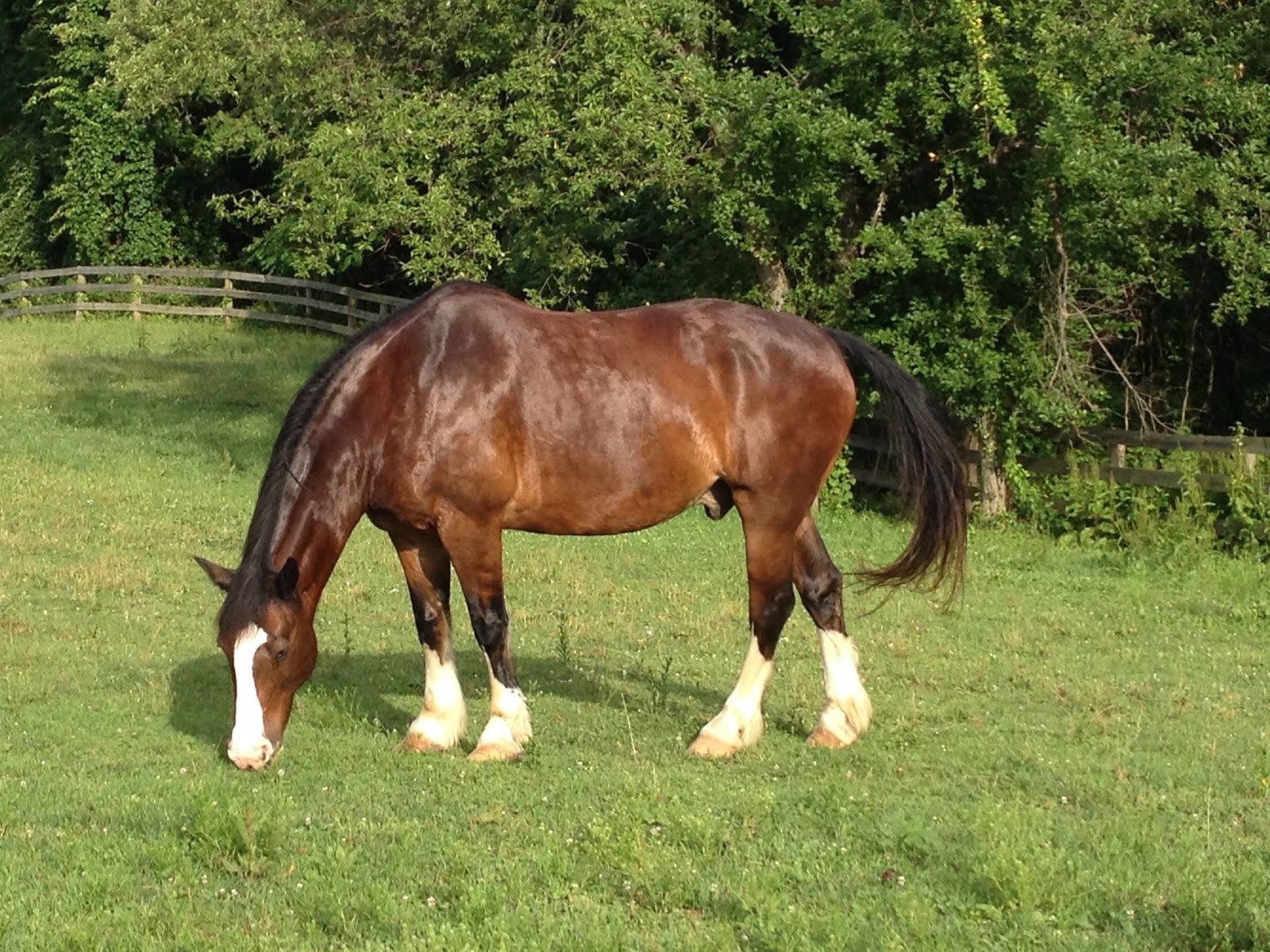
I'm facing a battle with one of the best horses I've ever owned. The battle is to keep him alive and it's being waged on two fronts. My beloved Clyde/TB, Paddy, has been diagnosed with Inflammatory Airway Disease (IAD/RAO) and at times during the hot, humid summers here in Maryland, his respiration has zoomed up to seventy respirations per minute. The oral steroid treatment caused a bout of laminitis, but the inhalant therapy gives him a large measure of comfort. That comfort comes with a huge price tag. (One inhalant can cost over $300 and only lasts a week during a severe flare up.) The second battle front opened recently when he was also diagnosed with Insulin Resistance (IR).  His diet was immediately modified to eliminate sugar and starches as much as possible and his time out on grass was cut down. He also can no longer be fed his beloved apples, carrots, sugar cubes and peppermint treats (although I did find some sugar-free mints). I feel guilty that I may have contributed to this by "killing him with kindness" and over feeding. Unfortunately, the recommended treatment for IR is to get him fit and to lose weight, but that is a challenging task when he can't breathe! Thus, the war on two fronts.


I have fought a good fight.  I've purchased a Haygain hay steamer, his stall is dust free, his food is weighed and I've done my best to get the weight off and improve fitness. Time will tell, but I'm not deluding myself---he could have to be put down if we can't get a handle on his problems. No pet owner wants to contemplate, let alone carry out, that task but it is our ultimate responsibility for each pet we take on.  It never gets easier. Moreover, if you do have to take that step, as an owner, friend, and partner, you don't want it to be for financial reasons.  Where horses are concerned, however, it sometimes is the case. I just don't want to look in Paddy's eye on that day and know that I could keep him alive if only I had a money tree. Believe me, I have taken the high road and done whatever was necessary in the past to prolong his life and keep hope afloat. I've nursed him through Potomac Fever, Equine Protozoal Myloencephalitis (EPM), and orthoscopic surgery before this latest affliction. Still. I wish I could wash my hands of this responsibility for life or death, but I can't. No owner can because they are depending on you to do what's right, no matter how hard it is.

Meanwhile, hope is still alive and I look for small signs of improvement. I take joy in every day I have him, whether he is rideable or not. I am eternally grateful for the past we shared,  I do what has to be done one day at a time, and try not to worry too much by peering into the uncertain future.

The passing of a beloved animal is a powerful transition for those who are left to mourn. It is no wonder that some fragments of these experiences have found their way into my stories and therefore have provided some measure of eternity for those departed friends.