Monday, June 29, 2015

Repurpose

Repurpose. A favorite word of mine. From the time I watched Molly Ringwald’s character stitch two unfashionable dresses into one masterpiece in Pretty In Pink I’ve loved the concept. Perhaps in part because it requires a certain flair of imagination, and because it gives new life to something that might otherwise be retired. Useless. Thrown out.

Yes, I’m a pack rat. A collector. Not quite a hoarder. But more than that, I enjoy giving things a second chance, as if at the end of one life they appear used up, but if you squint and really look at this object, you can come up with a second life for it. A new purpose.

My cousin Sandy lives with me. She is the cook in our family and by that token, she rules the rather large kitchen in my older farm house. Even with a table and chairs in it, my kitchen is too spacious not to have an island. We’ve had several, all of a temporary nature as we weren’t sure what we wanted.  Recently, Sandy purchased a small server that she found on Craigslist. The rest of its fellow dining room brethren had been sold and this little server stood alone. The cherry laminate was starting to buckle a bit on the top and it needed a good sanding and a touch of tong oil, but it was just the right size for my kitchen as a retro-repurposed island. My cousin's friend who is a wizard with woodworking created a butcher block top for the server. It is stunning and unique! Everyone who sees it, falls in love with it. Alone, it was a $25 server that was closer to being kindling than a useful piece of furniture again. Now, it’s a conversation piece, as well as a functional center to my kitchen.

I feel this way about animals too. Five years ago, I was scrolling through pages of photos of horses that were currently on a kill dealer’s lot. The horses had a week to enchant someone over the internet with their pictures and videos before being sent to slaughter. Every week I looked at those faces, some of them being photographed for the last time. I wanted to bring them all home but I had to be realistic.


Until November 2010.
While munching away at my usual breakfast of eggs and toast, I saw him. Liver chestnut, reportedly a Morgan without papers, wide, oddly shaped blaze. I pulled up all his pictures. I watched his video endlessly looking for lameness, attitude – anything that would explain why he was on the lot. Nothing. I thought about him all day. And the next day. And the day after that. Something about this liver chestnut gelding was sticking with me, but what was it? Nothing specific that I could pinpoint. All I knew was that he could not ship to slaughter – my gut told me that I could not let that happen.
And it didn’t. He was christened Galahad. The first time I saw him was after he’d made it safely to quarantine. He’s just a horse, I said to myself, trying to be rational. He won’t have any idea what happened or how hard I worked to save his life. And yet when I met him, he seemed very comfortable with me. He let me wrap his legs and blanket him. He followed me onto a trailer without a second thought. Within the first week, he accidentally opened his stall gate and strolled out. Before I could stop him, he was headed down the driveway toward the road. I thought I was going to be sick. It’s funny to think about it now. I yelled “Galahad!” from the barn and he stopped, turned around and came back to me.

I have no idea what his name was in his previous life, or why he answers to his new moniker but he always has. Perhaps it’s that he knows he’s mine and I’m his. Perhaps he’s just highly intelligent – he is always pulling something new from his bag of tricks. He bows and counts, much to the delight of guests. He neck reins and moves off my leg. He was an Amish buggy horse before I acquired him – his shaved forelock and road shoes gave him away. He has intermittent lameness issues and my equine dentist put him right around 20 years old. I fear one or both of these factors caused him to fail as a road horse and dropped him into the auction circuit.

But there are so many wonderful things about Galahad! He adjusts his mannerisms to his rider and only gives them what they can handle. I assume because of his Amish days, he never thinks to canter under saddle. It’s relaxing to know he’ll never try to take off with a green rider or a kid. Galahad is currently teaching my 7 year old nephew that horses aren’t something to be afraid of, but rather something wonderful and safe. He tolerates multiple sessions of my nephew just sitting on him, learning how to steer. He is patient and solid. Galahad has also taught my niece about herself. At times, he is the calm in the center of her turbulent teenage years.
And for me? Something spoke to me five years ago – something called out to me that this horse belonged on my farm. I didn’t need a driving horse, but then again Galahad’s driving days seemed behind him. I had no idea that he would be the horse I’d climb on bareback just to clear my head. That he’d be the horse I would start riding after I suffered a back injury that required time out of the saddle. That he would help heal the loss of my heart-horse in so many ways. That soon, a once Amish driving horse will be my partner in team sorting.  Something told me that that liver chestnut gelding needed a second chance, a new purpose. I listen to that voice every chance I get. 

Saturday, June 27, 2015


Worth Every Penny! 


In keeping with CNN’s current  series on the seventies, the star of my seventies was a Morgan gelding called Kanes’ Classic.

We had just sold a young, home-bred mare that I was showing for a lot of money and went looking another show horse.  My husband, Bob, and I were at a Morgan show several states away from our farm in Connecticut.  We sat in the stands during the park classes (I wanted a high-stepping park horse) and looked for something we thought was special.

We knew that most likely the horse we  wanted would not be openly for sale, but we didn’t think that purchasing that special horse would be impossible because, after all, we hadn’t planned on selling our special mare.

The first horse we took a shine to was a golden maned and tailed gelding.  Bob followed the horse and his rider back to their stalls and made an offer.  It was politely refused.  It’s interesting to note that this horse went on to win multiple championships at the top shows.  So I guess we at least had good taste.

The next horse that caught our fancy was Kane’s Classic.  Bob made an offer to the owner and it was accepted. We had a new horse!  And to sweeten the deal, we were able to take “Classy” back to our stalls and show him the remainder of the show.

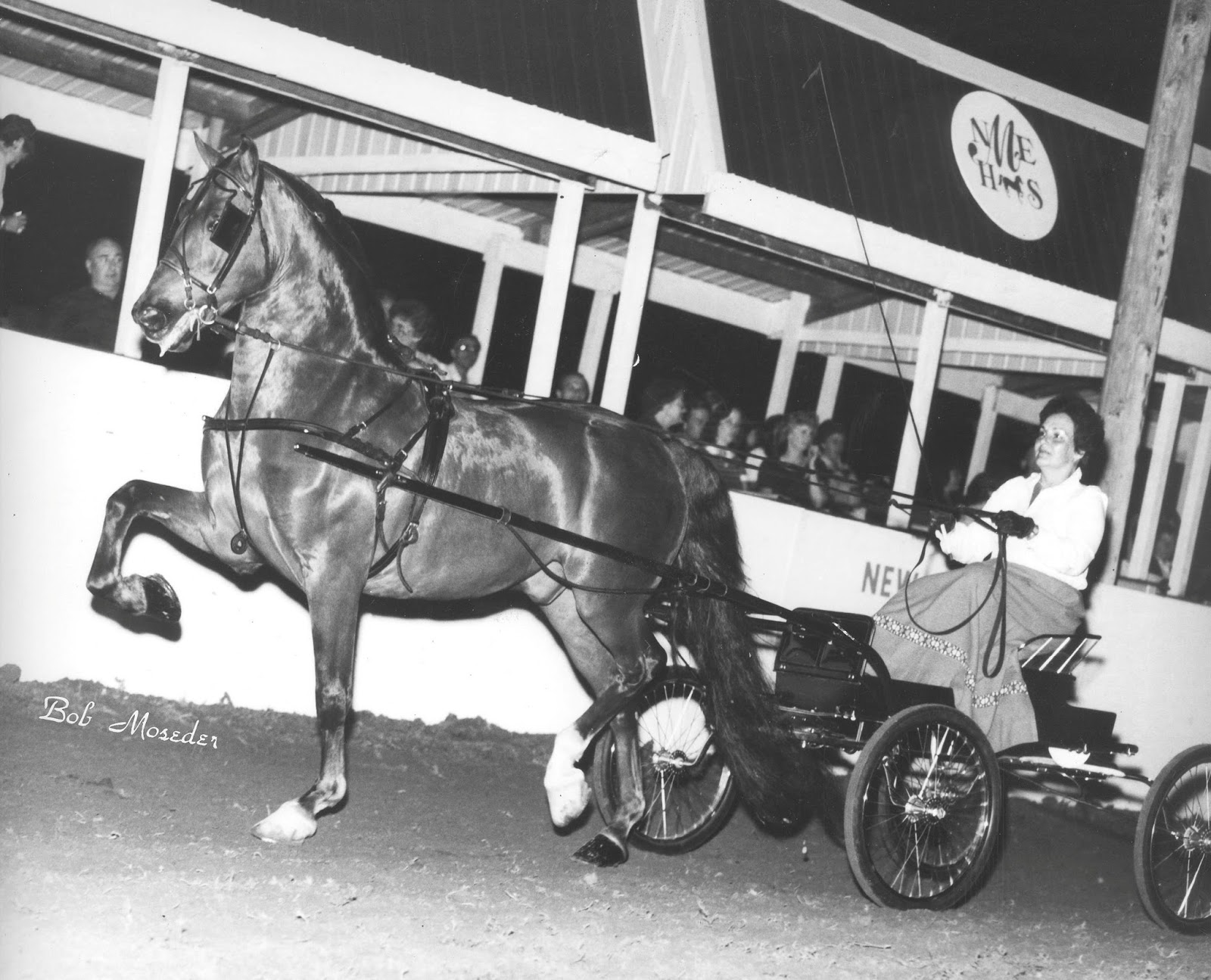
Kane's Classic winning Ladies Park Harness


Happily we went back to the motel that night, looking forward to getting to know our new horse.

When we got to the barn early the next morning, his stall was empty!  Bob stormed over to Classy’s former owner, demanding he bring the horse back to us.  Money had changed hands and a contract had been signed.

“My wife,” the man explained, “said she would divorce me if I sold Classy.”

Arms folded tightly across his chest, Bob fumed. He turned on his heels and began to walk away before he physically hurt the man.

“But,” the man said to my husband’s retreating back, “I can probably talk her into letting Classy go for another $500.”

My husband wanted no part of such unscrupulous dealings. However I was already picturing many blue ribbons with Classy.  I reasoned with him that we were prepared to pay more anyway, so we could afford the extra $500.  It took a lot of convincing, but to his credit, my husband swallowed his pride and forked over the additional $500.

As we walked away with Classy, the man said that he’d return the $500 once his wife calmed down. Never heard from him. That was forty years ago! 

Classy was worth every penny. We won countless ladies park harness classes and he soon earned the reputation of the horse to beat.


Isn't showing fun?!

This picture of me smiling through the mud, was taken after a major rain storm at an outdoor show.  I’m dressing is a saddlesuit and am sitting in a four-wheel show buggy; the typed used for park harness classes.  This particular class was a “Combination Park” class.  Horses worked a full class in harness then lined up.  Grooms came in, removed the buggy and harness and saddled the horses up.  Then the horses did a full walk, trot, canter saddle class. 

Come back next month and I’ll tell you all about the scariest adventure Classy and I had.  


Thursday, June 25, 2015


Giving characters a fair deal
By Carolyn Henderson

One of my best friends is a horse dealer. From the way some people react, I might just as well have said she was a drug dealer.
It’s too easy to think of dealers – and others in the horse world – in terms of stereotypes. There’s the cruel, unprincipled dealer who files horses’ teeth to make them look younger than they are and gives them mysterious substances to calm them down; the spoilt brat who doesn’t appreciate her expensive pony and gets her comeuppance when her poor but talented neighbour beats her in competition on her bargain buy; the rugged cowboy with a broken heart who is healed by a good woman and a troubled horse.
I could go on, but you’ll have met them all before. As writers, we have to be careful not to be lazy: when I wrote Beside Me, in which Luca, one of my main characters, is the son of a Romany horse dealer, I pinned a piece of paper over my desk on which I’d written NO STEREOTYPES in big letters. 
Fair enough, some dealers are awful. Diana Pullein-Thompson created a wonderfully believable one in A Pony For Sale: even her name, Lydia Pike, adds to the shudder factor. Showjumper Lydia and her mentor, the cruel and ignorant Jimmy, nearly ruin Martini, a talented pony.
A single vivid sentence sums up Lydia’s character and attitude: “On a wet May day I plaited her mane, pushed her head into my cheapest and most disreputable halter and sent her to Stringwell Market, where the quarterly Horse Sale was being held.”

A Pony For Sale has a happy ending, because Martini is bought and re-schooled by the sympathetic Lettie Lonsdale (another great name) and you know that they are going to ride off into the sunset together. I admit I find Lettie a bit drippy – the last line of the book is when she says, “And all my life,” I told the sleeping orchard, “I shall paint pictures and improve horses.”
My dealer friend doesn’t paint pictures, but she certainly improves horses. Here's a picture of an unhandled Irish Draught colt she spotted in the rough, taken three days after arrival. A year later, she'd transformed him into a champion show cob.
How’s that for inspiration?


Tuesday, June 23, 2015

My Favorite Saddle

by Linda Benson

Most of us ride in a saddle of some kind, right? (Unless you're a teenager, extremely athletic, climb up on anything, and stick to a horse like glue.) But for most people, whether you ride English, Western, or one of those teensy little racing saddles, this piece of equipment gives the rider more security on the horse's back, as well as stirrups for comfort.

Here's the saddle I acquired (somewhat serendipitously) and rode for many hundreds of miles and hours and hours and hours. Yes, it's Western.


If it looks a bit broken-in, well, it is. It was a used saddle when I got it, and was thrown in on a deal with a little bay horse I bought years ago. I sold the horse not too long after that, but kept the saddle because it was so darn comfortable. And I kept it and kept it and kept it. I rode all kinds of horses in it, and logged many, many miles training for, and riding my palomino horse in the Tevis Cup 100 mile/one day endurance ride. The wide stirrups that it came with made it exceptionally comfortable for long days in the saddle.

I had a crupper ring stitched into the back of it, and I put on new saddle strings and latigos, but other than that it is exactly as I acquired it decades ago. I have no idea of the maker, either, but it is certainly a well-made saddle. It held up for me, and I will probably never part with it!

What is your favorite saddle to ride? (We know you have a favorite.) Tell us in the comments!

Sunday, June 21, 2015

Sefton's Story, or Why I Love Research

                                                                     Milton C. Toby photograph
by Milton C Toby

Writing often is a solitary chore, at least for me, especially with a deadline looming. Researching a book or magazine article, on the other hand, usually is an enjoyable exercise in fettering out minutia and finding links between seemingly unrelated  facts. But more about that later.

July 20 fell on a Tuesday in 1982.

That morning, as they did every morning at the same time, members of the Household Cavalry--Queen Elizabeth II's official bodyguards--were making their way from the regiment's barracks in Knightsbridge to the Horse Guards Parade. The horses and riders were en route to the popular Changing of the Guard ceremony. At 10:40 am, as the procession passed through Hyde Park, a massive nail bomb hidden in the trunk of a Morris Marina parked on a side street exploded.

Thirty pounds of nails were packed around 25 pounds of explosive and the damage wrought by the bomb was enormous. Four members of the Blues & Royals were killed by the blast, and a number of soldiers and civilians were injured. In addition to the human casualties, seven of the regiment's horses were killed.

Sefton, an Irish-bred draft cross which had served with the regiment for several years, suffered severe injuries, including a severed jugular vein and 34 other shrapnel wounds. Many of Sefton's wounds were life-threatening; after 90 minutes of emergency treatment and eight hours of surgery by a team of cavalry and civilian veterinarians the horse's chances of survival were estimated at 50-50. Major Noel Carding, Veterinary Officer of the Household Calvary, directed the emergency first aid for Sefton and the other injured horses. He was said to be the first British military veterinarian in more than a half-century to treat cavalry horses suffering with wartime injuries.

Sefton survived the bombing and eventually returned to duty with the regiment as a national hero. Donations in Sefton's name exceeded 600,000 pounds and were used to construct a surgical wing at the Royal Veterinary College. He was retired from military service in 1984 and spent the rest of his years at the Home of Rest for Horses. His rider, Michael Pedersen, also survived the bombing but ever after was plagued with post-traumatic stress disorder. He committed suicide in 2012 after killing his two children.

The Irish Republican Army claimed responsibility for the Hyde Park bombing, and for another bombing later in the day at Regent's Park that killed seven members of a military band from the Royal Green Jackets regiment. The attacks were low points in Irish-British relations during the "Troubles." Jonathan Irwin, a prominent Irish bloodstock agent and head of the Goffs Thoroughbred sales organization, was disgusted by the bombings.

"Common ground between Ireland
and England"
Copyright 2009 Milton C. Toby
"I thought it important that England should realize that many Irish people felt real horror at the incident," Irwin wrote in his autobiography, "Jack & Jill: The Story of Jonathan Irwin." He organized a fund-raising effort that raised 47,000 Irish pounds from private donors. The money was used to purchase six cavalry horses for the British military.

"Horses have always been a kind of common ground between Ireland and England," Irwin wrote, "and I thought this would be a quiet, but symbolic, way of joining hands across the sea."  

So what's the connection between Sefton and research?

I came across Sefton's story without actually looking for it. I was in Ireland a few weeks ago doing preliminary research for a book about Shergar, a Thoroughbred stallion that was stolen from an Irish stud farm owned by the Aga Khan in 1983. Conventional wisdom is that the horse was taken by the Irish Republican Army and held for ransom--he never was recovered and no ransom was paid--but I think the story is more complicated. I touched base with Jonathan Irwin in County Kildare, who I knew from my days at The Blood-Horse, which led me to his book, which led me to Sefton.

Looking for one story, I stumbled across another interesting one. And that's why I love research!


Wednesday, June 17, 2015

Show Barn Blues


Wow! I am really bad at editorial calendars! 

You're supposed to decide what you're going to write, write it, edit it, and release it, right? Simple. For normal people.

Here's what I decided to do instead.

Write a novel.

Shelve it.

Write another novel, using characters from the shelved novel.

Decide I still really liked the shelved novel.

Edit the shelved novel to publish first.

Plan on changing second novel to make room for changes based upon the shelved novel.

DOES THIS MAKE SENSE?

Of course it doesn't.

I'm a writer and I don't have to make sense.

I know, I know, excuses, excuses. But this way you get two novels out of it, so I'm not sure what grounds anyone has to complain...

So here's the deal.

I based Show Barn Blues on big boarding stables I've worked at.
I'm working on Pride, the sequel to Ambition, featuring characters and plot lines from Show Barn Blues, a stand-alone novel that I wrote last summer but didn't publish. The thing was (as I wrote at my blog back in May), there were events and sequences in Show Barn Blues that I simply couldn't replicate in Pride. The sub-plot of developing farm land into golf courses, and what drives a trainer to continue in the business long after the thrill has gone, were too big to wedge into Pride, which is really about giving up control. Those two things don't blend at all.

I wanted to release Pride first because so many people have asked for it, and I respect that, but Show Barn Blues really has so much to offer. Grace Carter, a middle-aged hunter/jumper trainer, has given her life to the show business, trying to escape a childhood nightmare that never would have happened if she had stayed in the arena as she'd been told. At the same time, she is preserving her grandfather's old farm, the scene of her happiest memories. She's caught in the middle, trying to save the land that she wants nothing to do with. As developers circle her farm, Grace is trying to somehow salvage her future while accepting her past. Meanwhile, a new trail-riding boarder, Kennedy, is determined to change things for Grace and her arena-bound students.

This is a sample of Grace's point of view:

***

The next day, Colleen cancelled her Sunday evening lesson to take Bailey on a trail ride with Kennedy. I was already furious when Missy Ormond showed up to ride in a pair of jeans, which was strongly discouraged — I liked my students to have a professional appearance at all times — and I nearly spit nails when, while wiping off her tack after her riding lesson, she suggested that we all have a group trail ride in a few weeks.

I had been mulling over a new cancellation fee for all riding lessons. “What’s that?” I snapped, but Missy was so excited, she didn’t notice my tone.

“With a barbecue,” she went on enthusiastically. “We could use that old fire-pit, and roast marshmallows. Or make s’mores.”

“What old fire-pit?” I knew exactly where my grandfather’s fire-pit had been dug and bricked, but nobody else knew about it. Rather, nobody else had known about it. Was Kennedy going to dig out all of my skeletons and parade them around in front of me? I put things deep into closets for a reason.

Missy didn’t notice my sudden tension. She hopped down from Donner and ran up her stirrups. “It’s out by the lake,” she explained. “We could all ride to the lake and maybe the grooms or anyone who doesn’t want to ride can take out supplies and wait for us with the Gator. It’s an easy ride. It’s practically a road. Did you know there’s a road out there?”

“It’s an old Indian trail,” I muttered, and everyone in the tack room started clamoring to see it, unable to believe I had denied them the opportunity to ride on a real live Indian trail. “That lake has gators in it,” I added. “And moccasins.”

“So does all the water in Florida,” Missy said, cocky after a good ride. She’d gotten Donner around a three foot nine course without any dirty stops at all — Donner was known for dropping his shoulder when he did not feel that his rider was paying sufficient attention, sending said rider tumbling into the fence while he went the other way. “I might not have lived here my whole life, but I know that. Have you been to Gatorland Zoo? I held a baby gator there. It had its mouth taped shut.”

I had, but when I was ten or eleven, not when I was forty-four years old and the mother of three. “The gators out at the pond will not have their jaws taped shut,” I reminded her. “And horses don’t like them.”


“Oh, they’ll swim away when we come,” Missy laughed. “Kennedy says they’re afraid of horses.” She turned and led Donner back to the barn, his hooves ringing on the concrete pathway, the one we’d constructed over a perfectly good pathway of sand so that the boarders could keep their boots clean. I’d gone to insane lengths to provide affluent equestrians with a picture-perfect equine utopia, and now they all wanted to do was mess around in the woods and look at alligators. One had to wonder what the point of anything was.

***

This story is uniquely Floridian, and uniquely equestrian (as I hope that all of my stories have been). Whether you've devoted your life to horses or you've been an enthusiast, you'll recognize Grace, Kennedy, and the cast of boarders and students who make up the show barn at Seabreeze Stables. And if you've ever seen a "coming soon" sign go up in front of beloved woodlands, you'll be ready to fight alongside Grace to save the farm and everything that it stands for.

And I promise you, once I've finished Show Barn Blues and you're all distracted reading about Grace and friends, I'll finish Pride. Grace meets Jules. Oh, the fireworks.

Monday, June 15, 2015

Writing to Entertain and Educate

I love horse books. They entertain me because they cover one of my favourite topics; they also often have an educational element. You can never stop learning about horses and I enjoy a story in which I learn and am entertained.


I think this is particularly important for young readers who plan to have horses and for mature readers who know riding and horse care and don't want to read incorrect information in a story - it really detracts from enjoying the story.


I aim to educate in all of my novels and am excited that A Dollar Goes a Long Way, book 5 in my Free Rein series has just been released with the view to educate and entertain!


What book have you really enjoyed and learned from?